




 ZYNQ SOC验证设计:PS端DMA缓存数据到PS端DDR

上篇该系列博文中讲述W5500接收到上位机传输的数据,此后需要将数据缓存起来。当数据量较大或者其他数据带宽较高的情况下,片上缓存(OCM)已无法满足需求,这时需要将大量数据保存在外挂的DDR SDRAM中。
最简单的方式是使用Xilinx的读写地址库函数Xil_In32()和Xil_Out32(),当然不仅支持32bit位宽,还包括8 16和64bit。但这种方式每次读写都要占用CPU,无法在读写的同时接收后续数据或者对之前的数据进一步处理,也就无法形成类似FPGA逻辑设计中的“流水线结构”,此时前段数据缓存过程中,后段数据会被丢弃。所以,需要利用PS端CPU子系统内的专用硬件DMA完成高速的批量数据搬移工作。
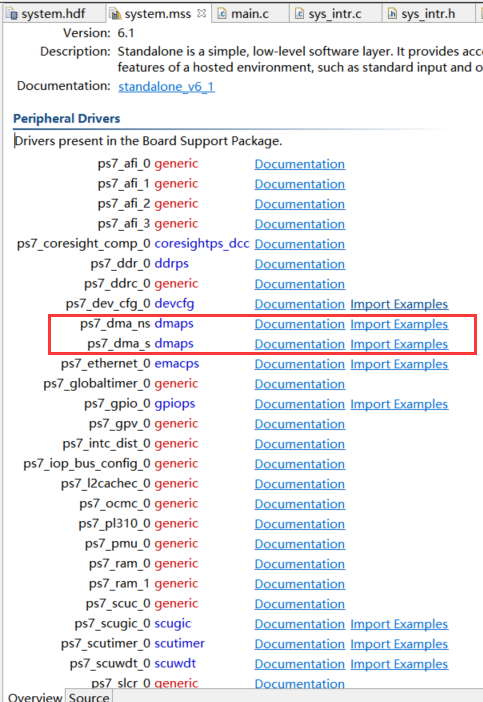
在Xilinx SDK的system.mss页面下直接导入ps_dma示例工程。
#include
#include
#include "sleep.h"
#include "xparameters.h"
#include "xil_types.h"
#include "xil_assert.h"
#include "xil_io.h"
#include "xil_exception.h"
#include "xil_cache.h"
#include "xil_printf.h"
#include "xscugic.h"
#include "xdmaps.h"
/************************** Constant Definitions *****************************/
/*
* The following constants map to the XPAR parameters created in the
* xparameters.h file. They are defined here such that a user can easily
* change all the needed parameters in one place.
*/
#define DMA_DEVICE_ID XPAR_XDMAPS_1_DEVICE_ID
#define INTC_DEVICE_ID XPAR_SCUGIC_SINGLE_DEVICE_ID
#define DMA_DONE_INTR_0 XPAR_XDMAPS_0_DONE_INTR_0
#define DMA_DONE_INTR_1 XPAR_XDMAPS_0_DONE_INTR_1
#define DMA_DONE_INTR_2 XPAR_XDMAPS_0_DONE_INTR_2
#define DMA_DONE_INTR_3 XPAR_XDMAPS_0_DONE_INTR_3
#define DMA_DONE_INTR_4 XPAR_XDMAPS_0_DONE_INTR_4
#define DMA_DONE_INTR_5 XPAR_XDMAPS_0_DONE_INTR_5
#define DMA_DONE_INTR_6 XPAR_XDMAPS_0_DONE_INTR_6
#define DMA_DONE_INTR_7 XPAR_XDMAPS_0_DONE_INTR_7
#define DMA_FAULT_INTR XPAR_XDMAPS_0_FAULT_INTR
#define TEST_ROUNDS 1 /* Number of loops that the Dma transfers run.*/
#define DMA_LENGTH 1024 /* Length of the Dma Transfers */
#define TIMEOUT_LIMIT 0x2000 /* Loop count for timeout */
/**************************** Type Definitions *******************************/
/***************** Macros (Inline Functions) Definitions *********************/
/************************** Function Prototypes ******************************/
int XDmaPs_Example_W_Intr(XScuGic *GicPtr, u16 DeviceId);
int SetupInterruptSystem(XScuGic *GicPtr, XDmaPs *DmaPtr);
void DmaDoneHandler(unsigned int Channel, XDmaPs_Cmd *DmaCmd,
void *CallbackRef);
/************************** Macro Definitions *****************************/
/************************** Variable Definitions *****************************/
#ifdef __ICCARM__
#pragma data_alignment=32
static int Src[DMA_LENGTH];
static int Dst[DMA_LENGTH];
#pragma data_alignment=4
#else
static int Src[DMA_LENGTH] __attribute__ ((aligned (32)));
static int Dst[DMA_LENGTH] __attribute__ ((aligned (32)));
#endif
XDmaPs DmaInstance;
#ifndef TESTAPP_GEN
XScuGic GicInstance;
#endif
/****************************************************************************/
/**
*
* This is the main function for the DmaPs interrupt example.
*
* @param None.
*
* @return XST_SUCCESS to indicate success, otherwise XST_FAILURE.
*
* @note None.
*
****************************************************************************/
#ifndef TESTAPP_GEN
int main(void)
{
int Status;
Status = XDmaPs_Example_W_Intr(&GicInstance,DMA_DEVICE_ID);
if (Status != XST_SUCCESS) {
xil_printf("Error: XDMaPs_Example_W_Intr failed/r/n");
return XST_FAILURE;
}
xil_printf("XDMaPs_Example_W_Intr passed/r/n");
return XST_SUCCESS;
}
#endif
/*****************************************************************************/
/**
*
* Interrupt Example to test the DMA.
*
* @param DeviceId is the Device ID of the DMA controller.
*
* @return XST_SUCCESS to indicate success, otherwise XST_FAILURE.
*
* @note None.
*
****************************************************************************/
int XDmaPs_Example_W_Intr(XScuGic *GicPtr, u16 DeviceId)
{
int Index;
unsigned int Channel = 0;
int Status;
int TestStatus;
int TestRound;
int TimeOutCnt;
volatile int Checked[XDMAPS_CHANNELS_PER_DEV];
XDmaPs_Config *DmaCfg;
XDmaPs *DmaInst = &DmaInstance;
XDmaPs_Cmd DmaCmd;
memset(&DmaCmd, 0, sizeof(XDmaPs_Cmd));
DmaCmd.ChanCtrl.SrcBurstSize = 4;
DmaCmd.ChanCtrl.SrcBurstLen = 4;
DmaCmd.ChanCtrl.SrcInc = 1;
DmaCmd.ChanCtrl.DstBurstSize = 4;
DmaCmd.ChanCtrl.DstBurstLen = 4;
DmaCmd.ChanCtrl.DstInc = 1;
DmaCmd.BD.SrcAddr = (u32) Src;
DmaCmd.BD.DstAddr = (u32) Dst;
DmaCmd.BD.Length = DMA_LENGTH * sizeof(int);
/*
* Initialize the DMA Driver
*/
DmaCfg = XDmaPs_LookupConfig(DeviceId);
if (DmaCfg == NULL) {
return XST_FAILURE;
}
Status = XDmaPs_CfgInitialize(DmaInst,
DmaCfg,
DmaCfg->BaseAddress);
if (Status != XST_SUCCESS) {
return XST_FAILURE;
}
/*
* Setup the interrupt system.
*/
Status = SetupInterruptSystem(GicPtr, DmaInst);
if (Status != XST_SUCCESS) {
return XST_FAILURE;
}
TestStatus = XST_SUCCESS;
for (TestRound = 0; TestRound xil_printf("Test round %d/r/n", TestRound);
for (Channel = 0;
Channel Channel++) {
/* Initialize source */
for (Index = 0; Index Src[Index] = DMA_LENGTH - Index;
/* Clear destination */
for (Index = 0; Index Dst[Index] = 0;
Checked[Channel] = 0;
/* Set the Done interrupt handler */
XDmaPs_SetDoneHandler(DmaInst,
Channel,
DmaDoneHandler,
(void *)Checked);
Status = XDmaPs_Start(DmaInst, Channel, &DmaCmd, 0);
if (Status != XST_SUCCESS) {
return XST_FAILURE;
}
TimeOutCnt = 0;
/* Now the DMA is done */
while (!Checked[Channel]
&& TimeOutCnt TimeOutCnt++;
}
if (TimeOutCnt >= TIMEOUT_LIMIT) {
TestStatus = XST_FAILURE;
}
if (Checked[Channel] /* DMA controller failed */
TestStatus = XST_FAILURE;
}
}
}
return TestStatus;
}
/******************************************************************************/
/**
*
* This function connects the interrupt handler of the interrupt controller to
* the processor. This function is seperate to allow it to be customized for
* each application. Each processor or RTOS may require unique processing to
* connect the interrupt handler.
*
* @param GicPtr is the GIC instance pointer.
* @param DmaPtr is the DMA instance pointer.
*
* @return None.
*
* @note None.
*
****************************************************************************/
int SetupInterruptSystem(XScuGic *GicPtr, XDmaPs *DmaPtr)
{
int Status;
#ifndef TESTAPP_GEN
XScuGic_Config *GicConfig;
Xil_ExceptionInit();
/*
* Initialize the interrupt controller driver so that it is ready to
* use.
*/
GicConfig = XScuGic_LookupConfig(INTC_DEVICE_ID);
if (NULL == GicConfig) {
return XST_FAILURE;
}
Status = XScuGic_CfgInitialize(GicPtr, GicConfig,
GicConfig->CpuBaseAddress);
if (Status != XST_SUCCESS) {
return XST_FAILURE;
}
/*
* Connect the interrupt controller interrupt handler to the hardware
* interrupt handling logic in the processor.
*/
Xil_ExceptionRegisterHandler(XIL_EXCEPTION_ID_IRQ_INT,
(Xil_ExceptionHandler)XScuGic_InterruptHandler,
GicPtr);
#endif
/*
* Connect the device driver handlers that will be called when an interrupt
* for the device occurs, the device driver handler performs the specific
* interrupt processing for the device
*/
/*
* Connect the Fault ISR
*/
Status = XScuGic_Connect(GicPtr,
DMA_FAULT_INTR,
(Xil_InterruptHandler)XDmaPs_FaultISR,
(void *)DmaPtr);
if (Status != XST_SUCCESS) {
return XST_FAILURE;
}
/*
* Connect the Done ISR for all 8 channels of DMA 0
*/
Status = XScuGic_Connect(GicPtr,
DMA_DONE_INTR_0,
(Xil_InterruptHandler)XDmaPs_DoneISR_0,
(void *)DmaPtr);
Status |= XScuGic_Connect(GicPtr,
DMA_DONE_INTR_1,
(Xil_InterruptHandler)XDmaPs_DoneISR_1,
(void *)DmaPtr);
Status |= XScuGic_Connect(GicPtr,
DMA_DONE_INTR_2,
(Xil_InterruptHandler)XDmaPs_DoneISR_2,
(void *)DmaPtr);
Status |= XScuGic_Connect(GicPtr,
DMA_DONE_INTR_3,
(Xil_InterruptHandler)XDmaPs_DoneISR_3,
(void *)DmaPtr);
Status |= XScuGic_Connect(GicPtr,
DMA_DONE_INTR_4,
(Xil_InterruptHandler)XDmaPs_DoneISR_4,
(void *)DmaPtr);
Status |= XScuGic_Connect(GicPtr,
DMA_DONE_INTR_5,
(Xil_InterruptHandler)XDmaPs_DoneISR_5,
(void *)DmaPtr);
Status |= XScuGic_Connect(GicPtr,
DMA_DONE_INTR_6,
(Xil_InterruptHandler)XDmaPs_DoneISR_6,
(void *)DmaPtr);
Status |= XScuGic_Connect(GicPtr,
DMA_DONE_INTR_7,
(Xil_InterruptHandler)XDmaPs_DoneISR_7,
(void *)DmaPtr);
if (Status != XST_SUCCESS)
return XST_FAILURE;
/*
* Enable the interrupts for the device
*/
XScuGic_Enable(GicPtr, DMA_DONE_INTR_0);
XScuGic_Enable(GicPtr, DMA_DONE_INTR_1);
XScuGic_Enable(GicPtr, DMA_DONE_INTR_2);
XScuGic_Enable(GicPtr, DMA_DONE_INTR_3);
XScuGic_Enable(GicPtr, DMA_DONE_INTR_4);
XScuGic_Enable(GicPtr, DMA_DONE_INTR_5);
XScuGic_Enable(GicPtr, DMA_DONE_INTR_6);
XScuGic_Enable(GicPtr, DMA_DONE_INTR_7);
XScuGic_Enable(GicPtr, DMA_FAULT_INTR);
Xil_ExceptionEnable();
return XST_SUCCESS;
}
/*****************************************************************************/
/**
*
* DmaDoneHandler.
*
* @param Channel is the Channel number.
* @param DmaCmd is the Dma Command.
* @param CallbackRef is the callback reference data.
*
* @return None.
*
* @note None.
*
******************************************************************************/
void DmaDoneHandler(unsigned int Channel, XDmaPs_Cmd *DmaCmd, void *CallbackRef)
{
/* done handler */
volatile int *Checked = (volatile int *)CallbackRef;
int Index;
int Status = 1;
int *Src;
int *Dst;
Src = (int *)DmaCmd->BD.SrcAddr;
Dst = (int *)DmaCmd->BD.DstAddr;
/* DMA successful */
/* compare the src and dst buffer */
for (Index = 0; Index if ((Src[Index] != Dst[Index]) ||
(Dst[Index] != DMA_LENGTH - Index)) {
Status = -XST_FAILURE;
}
}
Checked[Channel] = Status;
}
ps_dma_demo
其实demo中做的操作非常简单,仅仅是定义了两个数组Src和Dst,之后利用PS_DMA将Src中数据搬移到Dst中,搬移完成后进入中断函数比较两部分地址数据是否一致。Xilinx的SDK软件代码有固定的套路,“上有政策,下有对策”,我们可以将其封装成固定格式的一个个子函数,方便今后调用。这里把整个工程分为:系统中断,PS_DMA专有中断以及主函数三个部分。
#include "xscugic.h"
#include "sys_intr.h"
int sys_IntrInit(XScuGic *GicPtr)
{
XScuGic_Config *GicConfig;
/*
* Initialize the interrupt controller driver so that it is ready to
* use.
*/
int Status;
GicConfig = XScuGic_LookupConfig(INTC_DEVICE_ID);
if (NULL == GicConfig) {
return XST_FAILURE;
}
Status = XScuGic_CfgInitialize(GicPtr, GicConfig,
GicConfig->CpuBaseAddress);
if (Status != XST_SUCCESS) {
return XST_FAILURE;
}
return XST_SUCCESS;
}
void setupIntrException(XScuGic *GicPtr)
{
Xil_ExceptionInit();
/*
* Connect the interrupt controller interrupt handler to the hardware
* interrupt handling logic in the processor.
*/
Xil_ExceptionRegisterHandler(XIL_EXCEPTION_ID_IRQ_INT,
(Xil_ExceptionHandler)XScuGic_InterruptHandler,
GicPtr);
Xil_ExceptionEnable();
}
sys_intr.c
#ifndef SRC_SYS_INTR_H_
#define SRC_SYS_INTR_H_
#define INTC_DEVICE_ID XPAR_SCUGIC_SINGLE_DEVICE_ID
int sys_IntrInit(XScuGic *GicPtr);
void setupIntrException(XScuGic *GicPtr);
#endif /* SRC_SYS_INTR_H_ */
sys_intr.h
#include "xil_types.h"
#include "xdmaps.h"
#include "xscugic.h"
#include "psdma_intr.h"
int PS_DMA_IntrInit(XDmaPs *DmaInst,u16 DeviceId)
{
/*
* Initialize the DMA Driver
*/
int Status;
XDmaPs_Config *DmaCfg = NULL;
DmaCfg = XDmaPs_LookupConfig(DeviceId);
if (DmaCfg == NULL) {
return XST_FAILURE;
}
Status = XDmaPs_CfgInitialize(DmaInst,
DmaCfg,
DmaCfg->BaseAddress);
if (Status != XST_SUCCESS) {
return XST_FAILURE;
}
return XST_SUCCESS;
}
int PS_DMA_SetupIntr(XScuGic *GicPtr,XDmaPs *DmaPtr,unsigned Channel)
{
int Status;
/*
* Connect the device driver handlers that will be called when an interrupt
* for the device occurs, the device driver handler performs the specific
* interrupt processing for the device
*/
/*
* Connect the Fault ISR
*/
Status = XScuGic_Connect(GicPtr,
DMA_FAULT_INTR,
(Xil_InterruptHandler)XDmaPs_FaultISR,
(void *)DmaPtr);
if (Status != XST_SUCCESS) {
return XST_FAILURE;
}
/*
* Connect the Done ISR for all 8 channels of DMA 0
*/
Status = XScuGic_Connect(GicPtr,
DMA_DONE_INTR_0,
(Xil_InterruptHandler)XDmaPs_DoneISR_0,
(void *)DmaPtr);
/*Status |= XScuGic_Connect(GicPtr,
DMA_DONE_INTR_1,
(Xil_InterruptHandler)XDmaPs_DoneISR_1,
(void *)DmaPtr);
Status |= XScuGic_Connect(GicPtr,
DMA_DONE_INTR_2,
(Xil_InterruptHandler)XDmaPs_DoneISR_2,
(void *)DmaPtr);
Status |= XScuGic_Connect(GicPtr,
DMA_DONE_INTR_3,
(Xil_InterruptHandler)XDmaPs_DoneISR_3,
(void *)DmaPtr);
Status |= XScuGic_Connect(GicPtr,
DMA_DONE_INTR_4,
(Xil_InterruptHandler)XDmaPs_DoneISR_4,
(void *)DmaPtr);
Status |= XScuGic_Connect(GicPtr,
DMA_DONE_INTR_5,
(Xil_InterruptHandler)XDmaPs_DoneISR_5,
(void *)DmaPtr);
Status |= XScuGic_Connect(GicPtr,
DMA_DONE_INTR_6,
(Xil_InterruptHandler)XDmaPs_DoneISR_6,
(void *)DmaPtr);
Status |= XScuGic_Connect(GicPtr,
DMA_DONE_INTR_7,
(Xil_InterruptHandler)XDmaPs_DoneISR_7,
(void *)DmaPtr);*/
if (Status != XST_SUCCESS)
return XST_FAILURE;
/* Set the Done interrupt handler */
XDmaPs_SetDoneHandler(DmaPtr,
Channel,//Channel
DmaDoneHandler,//真正的中断函数
(void *)Checked);
/*
* Enable the interrupts for the device
*/
XScuGic_Enable(GicPtr, DMA_DONE_INTR_0);
/*
XScuGic_Enable(GicPtr, DMA_DONE_INTR_1);
XScuGic_Enable(GicPtr, DMA_DONE_INTR_2);
XScuGic_Enable(GicPtr, DMA_DONE_INTR_3);
XScuGic_Enable(GicPtr, DMA_DONE_INTR_4);
XScuGic_Enable(GicPtr, DMA_DONE_INTR_5);
XScuGic_Enable(GicPtr, DMA_DONE_INTR_6);
XScuGic_Enable(GicPtr, DMA_DONE_INTR_7);*/
XScuGic_Enable(GicPtr, DMA_FAULT_INTR);
return XST_SUCCESS;
}
void DmaDoneHandler(unsigned int Channel, XDmaPs_Cmd *DmaCmd, void *CallbackRef)
{
/* done handler */
volatile int *Checked = (volatile int *)CallbackRef;
//int Index;
int Status = 1;
xil_printf("Enter into the interrupt/n");
Checked[Channel] = Status;
}
void PS_DMA_InitPara(XDmaPs_Cmd* DmaCmd)
{
memset(DmaCmd, 0, sizeof(XDmaPs_Cmd));
DmaCmd->ChanCtrl.SrcBurstSize = 4;
DmaCmd->ChanCtrl.SrcBurstLen = 4;
DmaCmd->ChanCtrl.SrcInc = 1;
DmaCmd->ChanCtrl.DstBurstSize = 4;
DmaCmd->ChanCtrl.DstBurstLen = 4;
DmaCmd->ChanCtrl.DstInc = 1;
DmaCmd->BD.SrcAddr = (u32) Src;
DmaCmd->BD.DstAddr = (u32) DDR_BASEADDR;//Dst
DmaCmd->BD.Length = DMA_LENGTH * sizeof(int);
}
psdma_intr.c
#ifndef SRC_PSDMA_INTR_H_
#define SRC_PSDMA_INTR_H_
#define DMA_DONE_INTR_0 XPAR_XDMAPS_0_DONE_INTR_0
#define DMA_DONE_INTR_1 XPAR_XDMAPS_0_DONE_INTR_1
#define DMA_DONE_INTR_2 XPAR_XDMAPS_0_DONE_INTR_2
#define DMA_DONE_INTR_3 XPAR_XDMAPS_0_DONE_INTR_3
#define DMA_DONE_INTR_4 XPAR_XDMAPS_0_DONE_INTR_4
#define DMA_DONE_INTR_5 XPAR_XDMAPS_0_DONE_INTR_5
#define DMA_DONE_INTR_6 XPAR_XDMAPS_0_DONE_INTR_6
#define DMA_DONE_INTR_7 XPAR_XDMAPS_0_DONE_INTR_7
#define DMA_FAULT_INTR XPAR_XDMAPS_0_FAULT_INTR
#define DDR_BASEADDR 0x00600000//XPAR_PS7_DDR_0_S_AXI_BASEADDR 0x00100000
#define DMA_LENGTH 1024 /* Length of the Dma Transfers */
int Src[DMA_LENGTH] __attribute__ ((aligned (32)));
volatile int Checked[XDMAPS_CHANNELS_PER_DEV];
int PS_DMA_IntrInit(XDmaPs *DmaInst,u16 DeviceId);
int PS_DMA_SetupIntr(XScuGic *GicPtr,XDmaPs *DmaPtr,unsigned Channel);
void DmaDoneHandler(unsigned int Channel, XDmaPs_Cmd *DmaCmd, void *CallbackRef);
void PS_DMA_InitPara(XDmaPs_Cmd* DmaCmd);
#endif /* SRC_PSDMA_INTR_H_ */
psdma_intr.h
#include
#include
#include "sleep.h"
#include "xparameters.h"
#include "xil_types.h"
#include "xil_assert.h"
#include "xil_io.h"
#include "xil_exception.h"
#include "xil_cache.h"
#include "xil_printf.h"
#include "xscugic.h"
#include "xdmaps.h"
#include "sys_intr.h"
#include "psdma_intr.h"
#define DMA_DEVICE_ID XPAR_XDMAPS_1_DEVICE_ID
#define INTC_DEVICE_ID XPAR_SCUGIC_SINGLE_DEVICE_ID
#define TEST_ROUNDS 1 /* Number of loops that the Dma transfers run.*/
#define TIMEOUT_LIMIT 0x2000 /* Loop count for timeout */
static XScuGic GicInstance;
static XDmaPs DmaInstance;
static XDmaPs_Cmd DmaCmd;
unsigned int Channel = 0;
/************************** Function Prototypes ******************************/
int PS_DMA_WriteTest();
int SetupInterruptSystem(XScuGic *GicPtr, XDmaPs *DmaPtr);
void DmaDoneHandler(unsigned int Channel, XDmaPs_Cmd *DmaCmd,
void *CallbackRef);
int dataCheck(u32 baseAddr,u32 len);
int systemInit(XScuGic *GicPtr,u16 DeviceId);
int main(void)
{
int Status;
Status = systemInit(&GicInstance,DMA_DEVICE_ID);
if (Status != XST_SUCCESS) {
xil_printf("System initialization is failed/r/n");
return XST_FAILURE;
}
Status = PS_DMA_WriteTest();
if (Status != XST_SUCCESS) {
xil_printf("Error: XDMaPs_Example_W_Intr failed/r/n");
return XST_FAILURE;
}
xil_printf("Checking data.../n");
Status = dataCheck(DDR_BASEADDR,DMA_LENGTH);
if(Status != XST_SUCCESS)
{
xil_printf("Error:check failed/n");
return XST_FAILURE;
}
xil_printf("Writing data to DDR using DMA test passed!/r/n");
return XST_SUCCESS;
}
int dataCheck(u32 baseAddr,u32 len)
{
u32 DDR_ReadData[1024];
int i;
for(i=0;i {
DDR_ReadData[i] = Xil_In32(baseAddr+i*4);
if(DDR_ReadData[i]!=Src[i])
return XST_FAILURE;
//else //将写入DDR数据读回 并打印
// xil_printf("data at %x is %d/n",baseAddr+i*4,DDR_ReadData[i]);
}
return XST_SUCCESS;
}
/*****************************************************************************/
/**
*
* Interrupt Example to test the DMA.
*
* @param DeviceId is the Device ID of the DMA controller.
*
* @return XST_SUCCESS to indicate success, otherwise XST_FAILURE.
*
* @note None.
*
****************************************************************************/
int PS_DMA_WriteTest()
{
int Index;
int Status;
int TestStatus;
int TestRound;
int TimeOutCnt;
TestStatus = XST_SUCCESS;
for (TestRound = 0; TestRound xil_printf("Test round %d/r/n", TestRound);
for (Channel = 0;Channel {
/* Initialize source */
for (Index = 0; Index Src[Index] = DMA_LENGTH - Index;
Checked[Channel] = 0;
Status = XDmaPs_Start(&DmaInstance, Channel, &DmaCmd, 0);
if (Status != XST_SUCCESS) {
xil_printf("Starting the DMA is failed./n");
return XST_FAILURE;
}
xil_printf("Starting the DMA is successful./n");
TimeOutCnt = 0;
while (!Checked[Channel]
&& TimeOutCnt TimeOutCnt++;
}
/* Now the DMA is done */
xil_printf("Jump out of the interrupt/n");
if (TimeOutCnt >= TIMEOUT_LIMIT) {
xil_printf("Overtime!/n");
TestStatus = XST_FAILURE;
}
if (Checked[Channel] /* DMA controller failed */
xil_printf("Checking failure!/n");
TestStatus = XST_FAILURE;
}
}
}
return TestStatus;
}
int systemInit(XScuGic *GicPtr,u16 DeviceId)
{
xil_printf("Start to initialize interrupt system./n");
PS_DMA_InitPara(&DmaCmd);//主要设置DMA的源目的地址
//xil_printf("Configuring DMA parameters is successful./n");
int Status;
Status = PS_DMA_IntrInit(&DmaInstance,DeviceId);
if (Status != XST_SUCCESS) {
xil_printf("DMA initialization is failed./n");
return XST_FAILURE;
}
//xil_printf("DMA initialization is successful./n");
Status = sys_IntrInit(GicPtr);
if (Status != XST_SUCCESS) {
xil_printf("Initialization of the interrupt system is failed./n");
return XST_FAILURE;
}
//xil_printf("Initialization of the interrupt system is successful./n");
setupIntrException(GicPtr);
Status = PS_DMA_SetupIntr(GicPtr,&DmaInstance,Channel);//////////////////////////DMA中断入口///////////////////////
if (Status != XST_SUCCESS) {
xil_printf("Setting up DMA interrupt is failed./n");
return XST_FAILURE;
}
//xil_printf("Setting up DMA interrupt is successful./n");
xil_printf("System initialization is finished./n");
xil_printf("------------------------------------------/n");
return XST_SUCCESS;
}
main.c
上述代码的封装方式参考了米联客教程中的思想。先说明系统中断部分:sys_IntrInit()函数中进行查找表配置和中断控制器初始化操作,setupIntrException()函数负责使能中断异常处理。再来说说PS_DMA中断部分:PS_DMA_IntrInit()函数与系统中断中sys_IntrInit()从操作到格式几乎完成相同,亦是查找表配置和DMA的初始化。PS_DMA_SetupIntr()函数完成了中断源和中断控制器的连接和设置中断处理器,以及中断使能,也就是所有PS_DMA的专用中断操作。
PS_DMA_SetupIntr()内最重要的部分是XDmaPs_SetDoneHandler(),其相当于一个调用中断函数的通用处理框架,它的第三个参数DoneHandler才是真正的中断处理函数。这里涉及到C语言的高级话题:函数通过函数指针调用另一个函数,被函数指针调用的函数就是通常讲的“回调函数”了。指针调用函数的方式兼顾了程序的通用架构和灵活性,具体参考文章:不懂C语言回调函数,那就看这篇文章吧! - 简书 https://www.jianshu.com/p/2f695d6fd64f 在该程序中,中断回调函数为DmaDoneHandler()。
PS_DMA_InitPara()是自行添加的PS_DMA参数初始化函数,内部的参数更是重中之重了,我们来查看Xilinx官方文档ug585的DMA Controller章节。
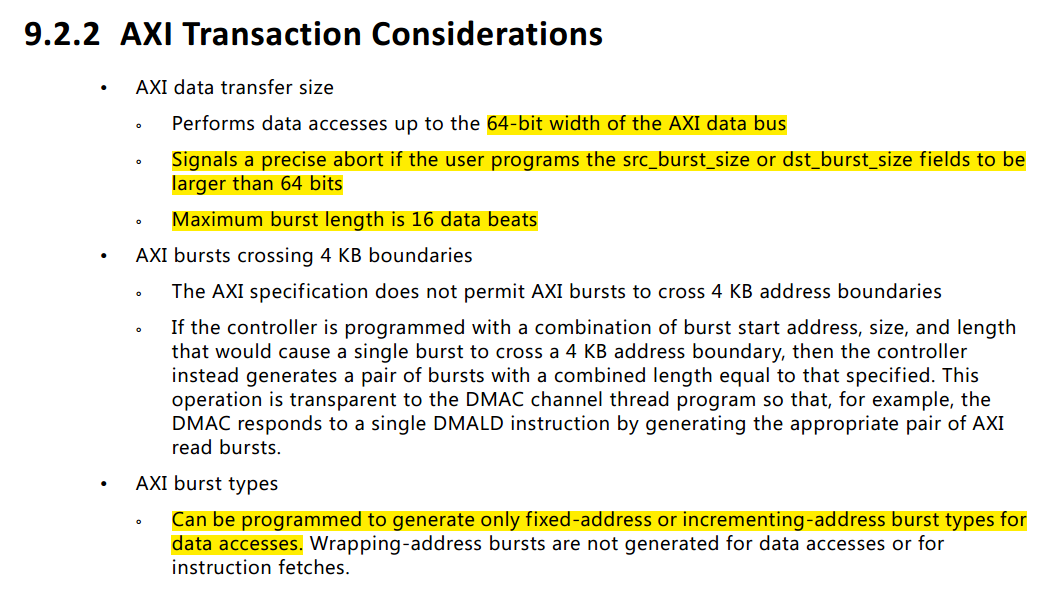
简要来说,DMA以burst形式传输数据,意思是分批次搬移。手册说明原或目的burst_size位宽不能超过64bit,这也是其挂载AXI总线的数据位宽。PS_DMA_InitPara()里的SrcBurstSize为源突发传输位宽字节数,最大为8.SrcBurstLen是手册中所说的“burst length”,即突发传输数据个数。SrcInc表示burst types为地址自增(1)还是地址固定(0)模式。目的控制字同理。剩下的三个参数最重要:SrcAddr DstAddr Length分别代表源首地址 目的首地址和一共需要搬移的数据字节数。需要注意的是,一定要满足srcburstsize*srcburstlen == dstburstsize*dstburstlen,否则发生错误。这一点也比较好理解,相当于FPGA逻辑设计中的异步FIFO两侧数据带宽要匹配。
那么要想完成OCM到DDR的数据搬移,改动下地址就可以嘛。由于读写DDR要访问绝对地址,所以要格外注意读写操作的地址不能和DDR内存储程序代码和中间数据的地址段重叠。避免程序崩溃很简单的做法就是在XPAR_PS7_DDR_0_S_AXI_BASEADDR 的基础上加一段偏移量,具体加多少的问题本人也不是很明确,希望看到的朋友能在评论中指点一二。
对于ZYNQ这一SOC架构来说,PS端连接如以太网,USB等高带宽外设计接口更加方便,所以PS_DMA的灵活运用还好是十分必要的,更灵活高效的利用这一硬件资源还要后期继续探索。PS端和PL端高速数据交互就需要用到另一个DMA成员AXI_DMA,可以说它利用片内总线打破了CPU+FPGA架构的性能瓶颈,该部分内容将在后续说明。
编辑:hfy
-
FPGA
+关注
关注
1656文章
22299浏览量
630640 -
以太网
+关注
关注
41文章
5929浏览量
179638 -
usb
+关注
关注
60文章
8375浏览量
281849 -
Zynq
+关注
关注
10文章
625浏览量
49254
发布评论请先 登录
伟创力珠海B11工厂完成SMT端到端示范验证
如何训练好自动驾驶端到端模型?

基于AXI DMA IP核的DDR数据存储与PS端读取
使用AXI4接口IP核进行DDR读写测试
端到端智驾模拟软件推荐——为什么选择Keymotek的aiSim?
自动驾驶中端到端仿真与基于规则的仿真有什么区别?
自动驾驶中“一段式端到端”和“二段式端到端”有什么区别?

双Zynq MPSoC PS侧PCIe高速DMA互连解决方案
ZYNQ PS与PL数据交互方式
自主工具链助力端到端组合辅助驾驶算法验证
端到端数据标注方案在自动驾驶领域的应用优势
ZYNQ FPGA的PS端IIC设备接口使用
技术分享 |多模态自动驾驶混合渲染HRMAD:将NeRF和3DGS进行感知验证和端到端AD测试











 工商网监
工商网监
评论