 电子发烧友App






C++异常化处理
OLLVM-控制流平坦化
Two Puzzles
Exception
一般碰到C++异常逆向,确定了异常分发、处理部分,直接把call throw改为jmp catch块,再F5即可。 PS: 多个catch块根据rdx来当为异常处理数值决定哪个为对应的catch块。 关于以上,这篇讲的很详细: https://4nsw3r.top/2022/02/03/SCTF-REVERSE-CplusExceptionEncrypt-%E8%B5%9B%E5%90%8E%E5%A4%8D%E7%8E%B0/#Clang-x64 然而,这题没这么简单,套了个ollvm!?基于异常处理的ollvm,无论从哪个角度都没法使用之前的老套路。 耐心看完这两篇文章就会有所收获,对于此题的被异常处理搞乱掉的cfg就会有所理解。 https://www.cnblogs.com/catch/p/3604516.html https://www.cnblogs.com/catch/p/3619379.html
OLLVM
要是平常的ollvm都可以按照这篇来解决: https://bluesadi.github.io/0x401RevTrain-Tools/angr/10_%E5%88%A9%E7%94%A8angr%E7%AC%A6%E5%8F%B7%E6%89%A7%E8%A1%8C%E5%8E%BB%E9%99%A4%E6%8E%A7%E5%88%B6%E6%B5%81%E5%B9%B3%E5%9D%A6%E5%8C%96/ 其他的原理讲的非常好,问题是这题并不是那么简单,但为了去ollvm我们的思路也是一样的,所以要对ollvm的cfg熟悉,并懂得我们该如何恢复一个被ollvm混淆后的代码。 现在就开始写我对这题的看法! 参考Write up: https://github.com/Lnkvct/CTF-for-Fun/blob/main/Challenges/Inflated-ACTF2022/writeup.md https://www.cnblogs.com/FW-ltlly/p/16472171.html lchild师傅的Write up(pdf所以没法给链接)
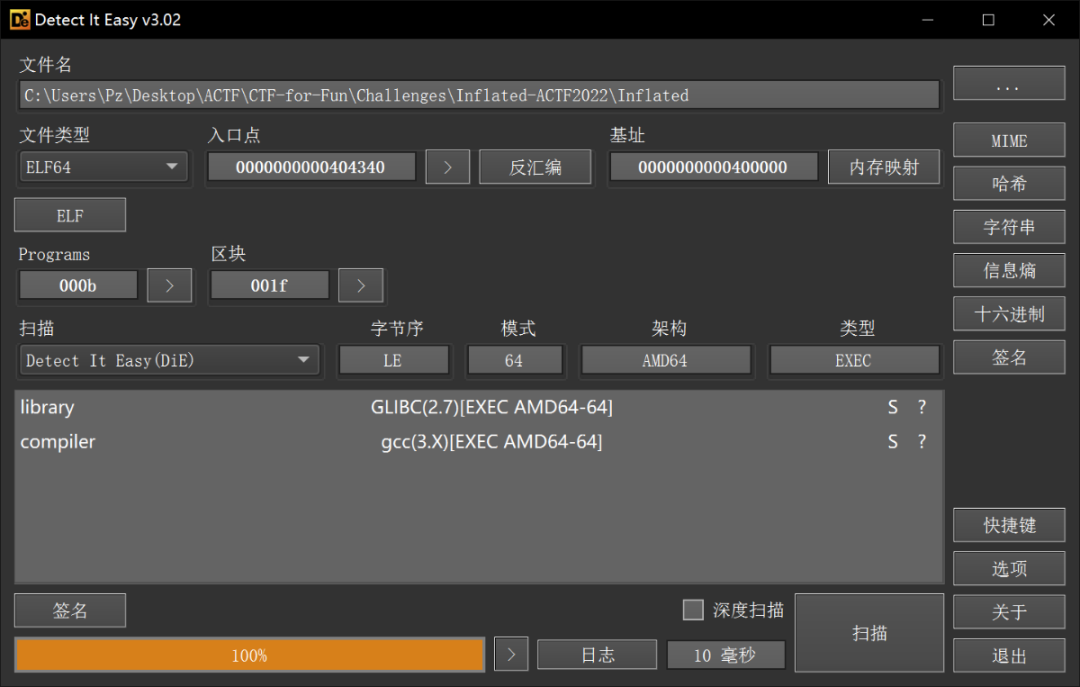
0x00 日常查壳
(感觉好久没写wp了) 无壳64位
0x01 CFG
GETC
在讲这题ollvm与异常处理之前,有必要先搞懂我们到底是怎么输入的。 一共有三处getc处理我们第一段输入的地方。
407629
40553A(专门用来处理箭头)
405676(专门用来处理箭头)
程序最先开始运行的是 407629,这里我们可以输入上下左右箭头与特定的数字。
如果是数字,程序读取加密进行存放
如果是箭头,会继续进行处理
(同时我们的输入还会决定异常类型)
Official Write up: The value of the first field of the thrown StdObfException object comes from the second input passed to the construct of StdObfException.
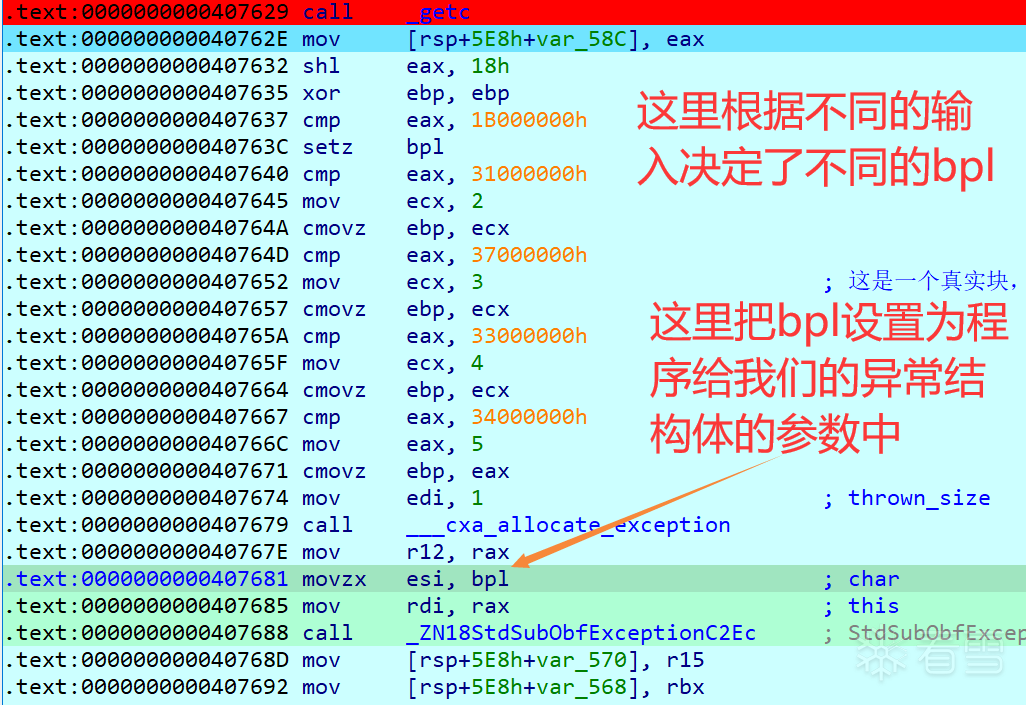
那么异常处理先不深究,继续回来箭头如何处理这个问题。那么箭头其实为三字节码,上下左右箭头分别对应 ^[[A ^[[B ^[[C ^[[D。此时开始动调,我第一次输入为上箭头,同时注意RAX。 那么在 407629 第一次处理箭头会读取为1B。

随后到 40553A 读取为5B。

最后到达 405676 可以发现我们的上箭头代码所对应的字符为A。

以上就解释了第一段输入的处理,等到最后解密第一段输入就会用到此。
OLLVM
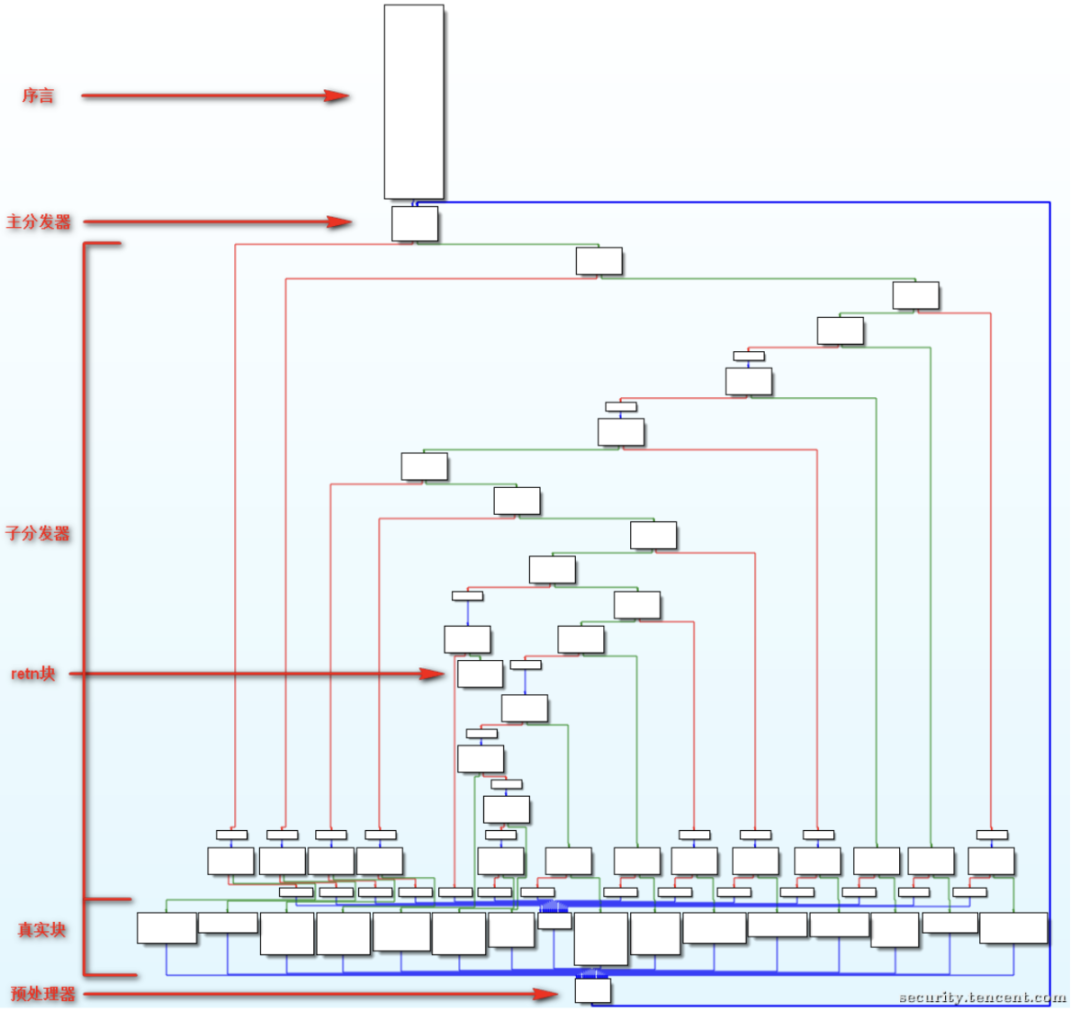
引用这张图,想要去掉ollvm最基本的是要认识这几个块。 https://security.tencent.com/index.php/blog/msg/112
先抛去原题,来认识一下这些名词:
函数的开始地址为序言(Prologue)的地址
序言的后继为主分发器(Main dispatcher)
后继为主分发器的块为预处理器(Predispatcher)
后继为预处理器的块为真实块(Relevant blocks)
无后继的块为retn块
剩下的为无用块与子分发器(Sub dispatchers)
那参考文章,总结来说,利用angr符号执行去除控制流平坦化的步骤可以归结为三个步骤:
静态分析CFG得到序言/入口块(Prologue)、主分发器(Main dis。
patcher)、子分发器/无用块(Sub dispatchers)、真实块(Relevant blocks)、预分发器(Predispatcher)和返回块(Return)。
利用符号执行恢复真实块的前后关系,重建控制流。
根据第二步重建的控制流Patch程序,输出恢复后的可执行文件。
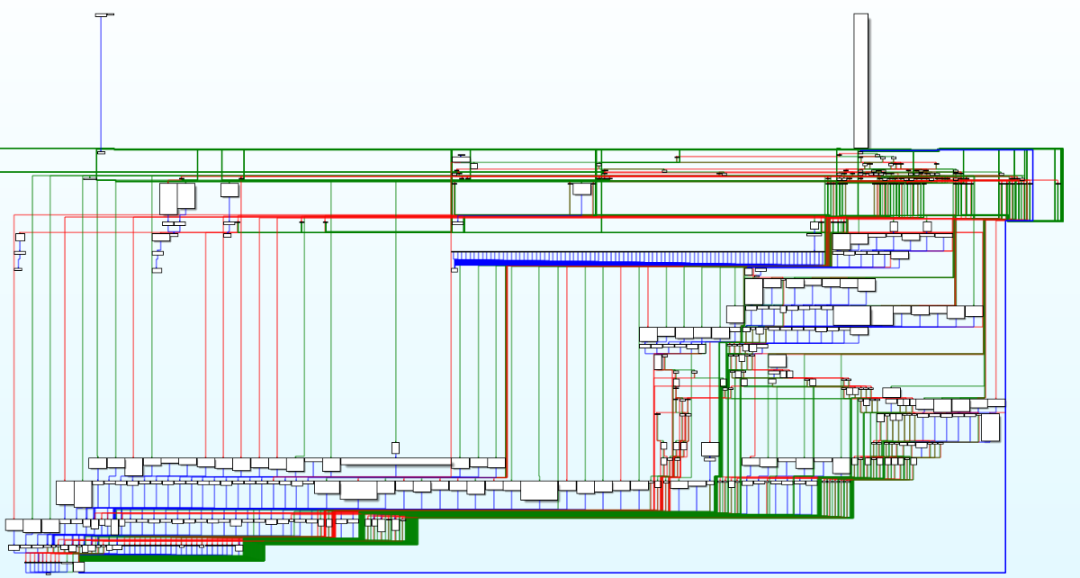
简单来说就是获取所有的块,利用angr符号执行我们的真实块,查看真实块之间的流程,再抛去我们不要的块,patch程序,完成! (那么具体的实现看文章) https://bluesadi.github.io/0x401RevTrain-Tools/angr/10_%E5%88%A9%E7%94%A8angr%E7%AC%A6%E5%8F%B7%E6%89%A7%E8%A1%8C%E5%8E%BB%E9%99%A4%E6%8E%A7%E5%88%B6%E6%B5%81%E5%B9%B3%E5%9D%A6%E5%8C%96/ 然而这题根本不像啊!可以看出这题的CFG根本看不懂,不像单单ollvm混淆过的cfg那么漂亮。
Exception
为了搞懂CFG为什么成这样了,得先了解下异常的原理,参考原文: https://www.cnblogs.com/catch/p/3604516.html 对于最基本的thown catch不再赘述,这篇讲到很清楚: https://4nsw3r.top/2022/02/03/SCTF-REVERSE-CplusExceptionEncrypt-%E8%B5%9B%E5%90%8E%E5%A4%8D%E7%8E%B0/#Clang-x64
异常抛出后,发生了什么事情?
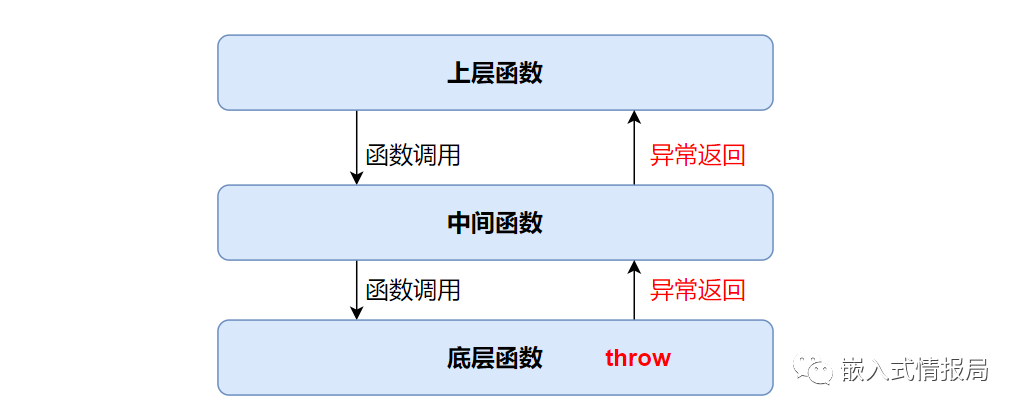
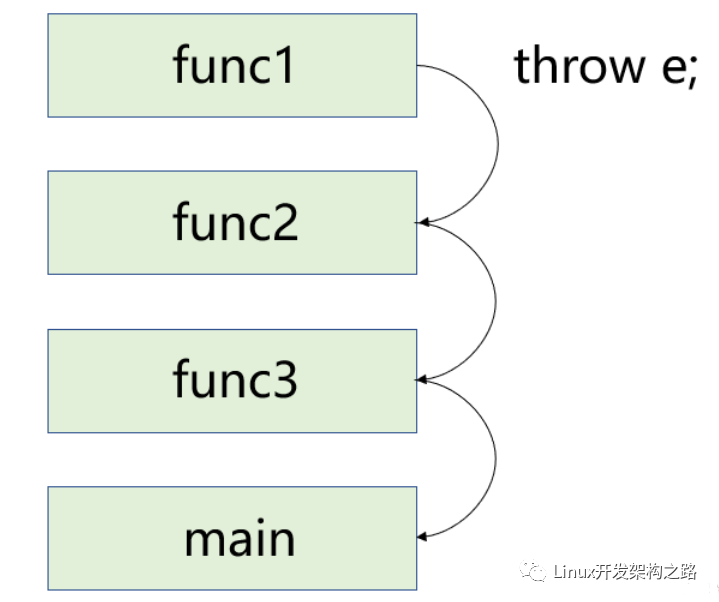
1、如果当前函数没有catch,就沿着函数的调用链继续往上抛,然后出现两种情况:
在某个函数中找到相应的catch;
没找到相应的catch,调用 std::terminate() (这个函数是把程序abort)。
2、如果想找到了相应的catch,执行相应的操作。
程序中catch的代码块有个专有名词:Landing pad
3、从抛异常到开始 -> 执行Landing pad代码 这整个过程叫作Stack unwind。
Stack unwind 从抛异常函数开始,对调用链上的函数逐个往前查找Landing pad。 如果没有找到Landing pad则把程序abort,如果找到则记下Landing pad的位置,再重新回到抛异常的函数那里开始,一帧一帧地清理调用链上各个函数内部的局部变量,直到 landing pad 所在的函数为止。
void func1()
{
  cs a; // stack unwind时被析构。
  throw 3;
}


void func2()
{
  cs b;
  func1();
}


void func3()
{
  cs c;
  try
  {
    func2();
  }
  catch (int)
  {
    //进入这里之前, func1, func2已经被unwind.
  }
}
stack unwind的过程可以简单看成函数调用的逆过程,这个过程在实现上由一个专门的stack unwind库来实现。
stack unwind库在intel平台上
属于Itanium ABI 接口中的一部分
与具体的语言无关,由系统实现
任何上层语言都可以通过这个接口的基础实现各自的异常处理
GCC就是通过这个接口实现C++的异常处理
Itanium C++ ABI
ltanium C++ ABI定义了一系列函数以及数据结构来建立整个异常处理的流程及框架,主要函数包括以下列:
_Unwind_RaiseException,
_Unwind_Resume,
_Unwind_DeleteException,
_Unwind_GetGR,
_Unwind_SetGR,
_Unwind_GetIP,
_Unwind_SetIP,
_Unwind_GetRegionStart,
_Unwind_GetLanguageSpecificData,
_Unwind_ForcedUnwind
其中 _Unwind_RaiseException() 函数进行stack unwind,它在用户执行throw的时被调用。 主要功能: 从当前函数开始,对调用链上的每一个函数都调用一个叫做 personality routine 的函数(__gxx_personality_v0)。 personality routine 该函数由上层的语言定义及提供实现。 _Unwind_RaiseException() 会在内部把函数栈调用现场重现,然后传给 personality routine,该函数主要做两件事情: 1、检查当前函数是否有相对应的catch; 2、清理调用栈上的局部变量。 那么稍稍总结一下,就是当程序抛出异常就要进行 stack unwind 操作。 而这个操作具体是 _Unwind_RaiseException() 中的 personality routine() 实现了检查catch和清理栈上的局部变量。
C++ ABI
基于前面介绍的 ltanium ABI,编译器层面也定义了一系列 ABI 与之交互。 当我们在代码中写下 throw xxx,编译器会分配一个数据结构 __cxa_exception 来表示该异常,该异常也有一个头部,定义如下:
struct __cxa_exception
{
  std::type_info *    exceptionType;
  void (*exceptionDestructor) (void *);
  unexpected_handler    unexpectedHandler;
  terminate_handler    terminateHandler;
  __cxa_exception *    nextException;


  int     handlerCount;
  int     handlerSwitchValue;
  const char *     actionRecord;
  const char *     languageSpecificData;
  void *     catchTemp;
  void *     adjustedPtr;


  _Unwind_Exception    unwindHeader;
};
当用户 throw 一个异常时,编译器会帮我们调用相应的函数分配出如下的结构:
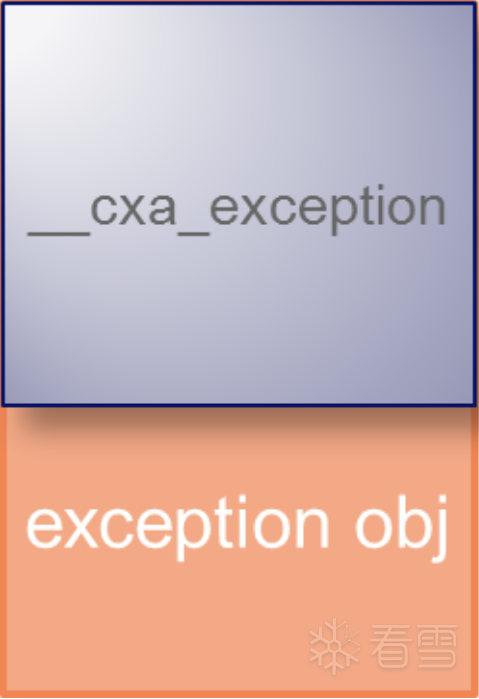
异常对象由函数 __cxa_allocate_exception() 进行创建
最后由 __cxa_free_exception() 进行销毁
当我们在程序里执行了抛出异常的操作,编译器为我们做了如下的事情: 1、调用 cxa_allocate_exception 函数,分配一个异常对象(cxa_exception,数据结构如上)。 2、调用 __cxa_throw 函数,这个函数会将异常对象做一些初始化。 3、__cxa_throw() 调用 Itanium ABI 里的 _Unwind_RaiseException() 从而开始 unwind。 4、_Unwind_RaiseException() 对调用链上的函数进行 unwind 时,调用 personality routine()。 5、该异常如能被处理(有相应的 catch),则 personality routine 会依次对调用链上的函数进行清理。 6、_Unwind_RaiseException() 将控制权转到相应的catch代码。 7、unwind 完成,用户代码继续执行。 总结太Bravo了!
再看异常处理
有了这些前置知识,再看题目中的异常,由前面描述可知实现 unwind stack 的具体过程是通过 __gxx_personality_v0(即personality routine)实现。 这时候我们再去IDA里调整此函数。
_Unwind_Reason_Code __fastcall _gxx_personality_v0(
        int Version,
        _Unwind_Action actions,
        __int64 exceptionClass,
        _Unwind_Exception *exceptionObject,
        _Unwind_Context *context)
光标在函数,按Y修改类型。
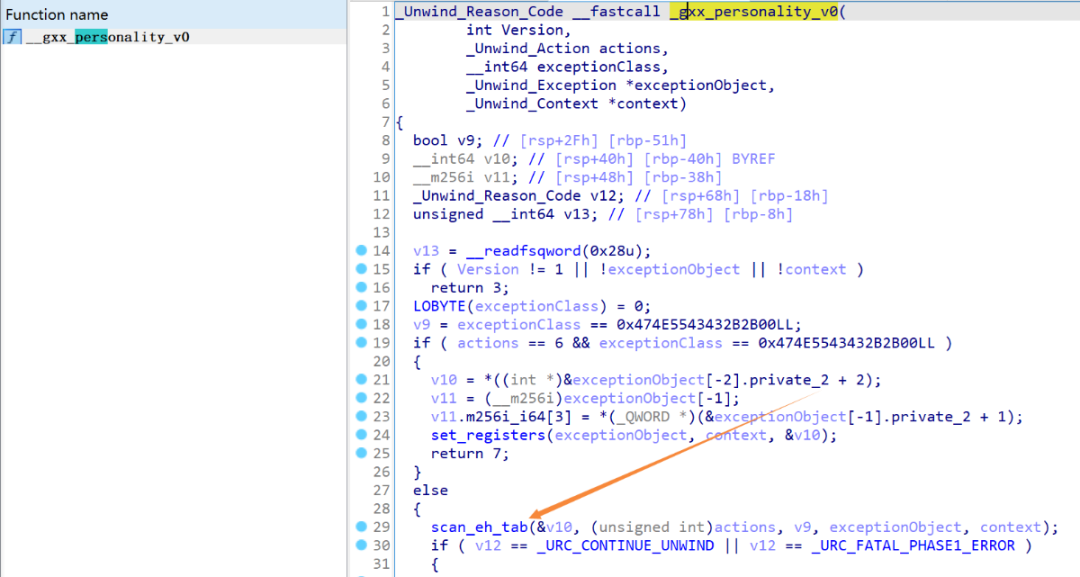
检查当前函数是否有相应的 catch 语句。
清理当前函数中的局部变量。
在personality routine()下的 scan_eh_tab() 该函数有我们最关心的两个值,同时也是魔改处。
与源码对比:https://code.woboq.org/llvm/libcxxabi/src/cxa_personality.cpp.html#__cxxabiv1::scan_eh_tab
Shfit + F1 -> INS 导入结构体。
struct scan_results
{
int64_t ttypeIndex;
const uint8_t* actionRecord;
const uint8_t* languageSpecificData;
uintptr_t landingPad;
void* adjustedPtr;
_Unwind_Reason_Code reason;
};
光标在scan_eh_tab函数上按Y修改。
void scan_eh_tab(scan_results *results, _Unwind_Action actions, bool native_exception, _Unwind_Exception *unwind_exception, _Unwind_Context *context)Landing pad Landing pad(指向catch块的分发处,只单单拿到landing pad还不够,这时候还缺少一个对应异常类型ttypeIndex)。
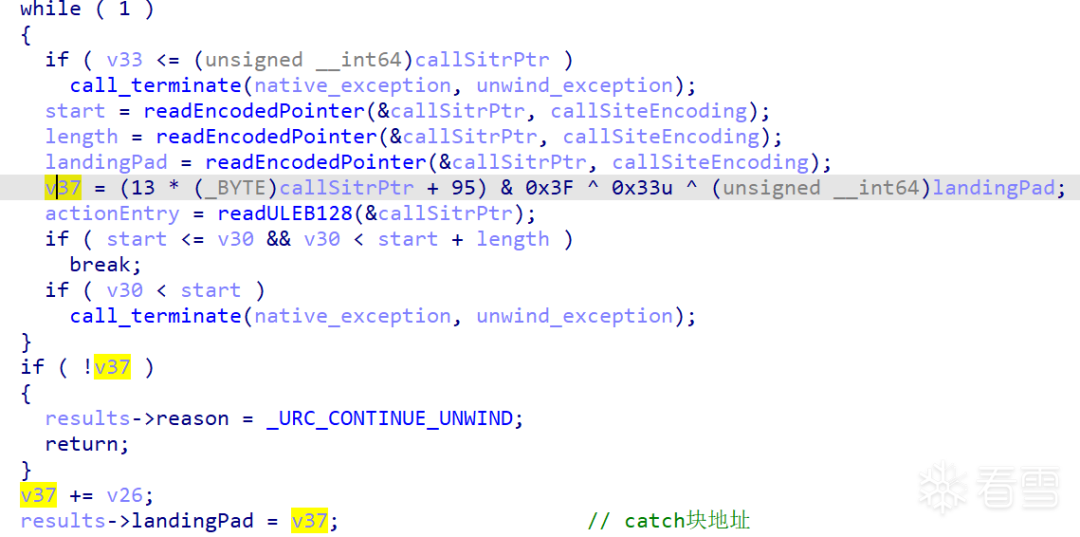
ttypeIndex
首先要求父类为StdObfException的异常。 最后的ttypeIndex由 thrown_object_ptr(由我们的第一段输入所决定的thrown_object_ptr) 和 原始固定固定typeIndex 决定。
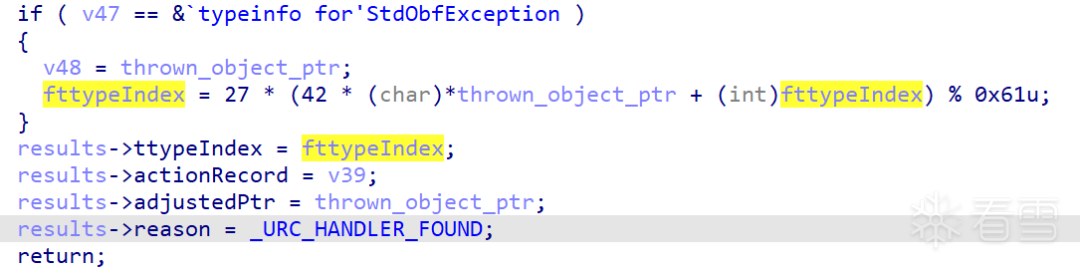
Official Write up: And we have figured out that the ttypeIndex is determined by the first field of the thrown StdObfException object and the lptinfo passed to __cxa_throw. The value of the first field of the thrown StdObfException object comes from the second input passed to the construct of StdObfException. 那么这两个值到底具体指的是什么?? 其实上面已经给出了答案,反复调试可知,可以发现我们的第一段输入设置了父类StdObfException。 the first field of the thrown StdObfException object 指的就是我们的输入。 the lptinfo passed to __cxa_throw 指的就是当 ___cxa_allocate_exception 创建的异常,也就是固定的。
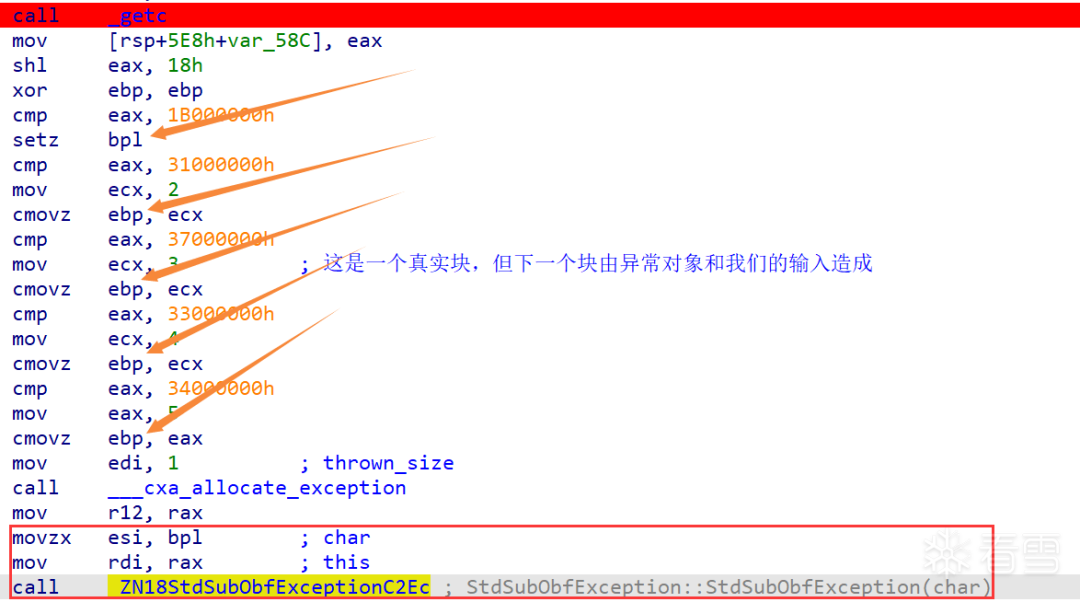
现在知道了魔改后的流程是从哪里来到哪里去,人工方式就是跳到landing pad再设置rdx为ttypeIndex就可以到达我们所对应的catch块。
什么叫CFG!
那么现在知道了routine personality 中的 scan_eh_tab被修改了,而IDA平常能识别throw catch这些块的原因就是这些正常的源码。 然而landingpad与ttypeIndex都被修改了,所以导致了IDA识别的CFG成了这个样子。 我们根本没法用肉眼知道throw的块在哪,只有通过动调才能确定,然而这就导致了原先的deflat脚本都不不行了。 原因主要为两点: 1、无法确定throw后的块; 2、throw可能对着多个catch块,这时候就通过rdi(ttypeIndex)进行catch块分发(landingPad)。 原因还有种种就不一一举例,就无法正常原先deflat所需要的CFG块。
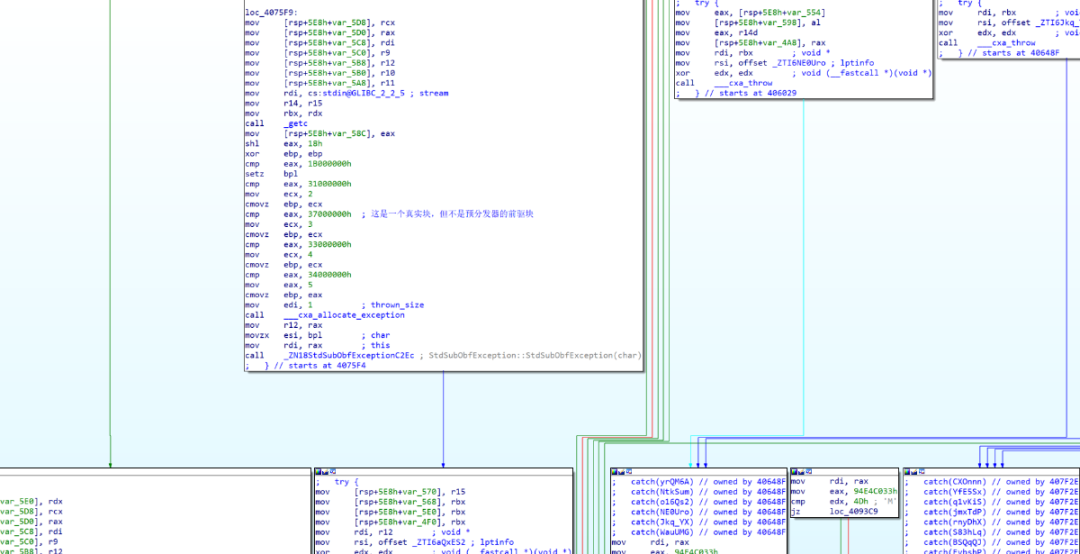
以下开始就是跟着官方脚本复现。我们再回忆一下正常的ollvm的执行流程: Prologue(入口块)-> Main dispatcher(主分发器)-> Sub dispathers(子分发器)-> Relevant blocks(真实块)-> Predispather(预分发器)-> Main dispatcher(主分发器)... 总结一下这道题的CFG。 我们的下一个真实块取决于系统生产的lptinfo和我们的第一段输入所导致的StdObfException,在每个真实块的结束,我们不只是跳往与预分发器,而是调用 __cxa_throw 进行第二次调度,我们称二次调用为 second dispatch。 所以我们的执行流就是: ... -> main dispatcher -> sub dispatchers -> relevant block -> throw StdObfException exception -> Secondary dispatchers -> pre-dispatcher -> main dispatcher -> ... 除此之外,程序还抛出了一些真正的异常,对于这些异常,第二次调用发生于Landing pad末尾。 ... -> main dispatcher -> sub dispatchers -> relevant block that throws real exceptions -> the according real LandingPad block -> throw StdObfException exception -> Secondary dispatchers -> pre-dispatcher -> main dispatcher -> ...
0x02 Deflat Solution
去该平坦化控制流,有两个步骤:
找到所有的真实块
找到真实块之间的关系
Find all relevant blocks
我们可以从主分发器开始寻找,找到所有子分发器的后继者,这些后继者本身不是子分发器。 官方WP中一眼丁真发现子分发器由该指令格式组成。
sub dispathers such as:
cmp
jx
于是由此区别出来:
isCmpRI = lambda instr: instr.mnemonic == "cmp" and
  hasattr(instr.operands[0], "_X86RegisterOperand__key") and
  hasattr(instr.operands[1], "_X86ImmediateOperand__key")
isCJmp = lambda instr: instr.mnemonic.startswith("j") and
  instr.mnemonic != "jmp"
isSubDispatcher = lambda bb: (len(bb.instrs) == 2) and
   isCmpRI(bb.instrs[0]) and isCJmp(bb.instrs[1])
首先判断是否为子分发器,然后排除法找到所有真实块。
class PatchHelper:
  ## ......
  # To get all cfgs
  def block(self, addr):
    bb = self.cfg.find_basic_block(addr)
    if bb is None:
      bb = barf.bb_builder.strategy._disassemble_bb(addr, barf.binary.ea_end, {})
    return bb

def get_relevant_blocks(cfg, patch_helper, main_dispatcher):
  isCmpRI = lambda instr: instr.mnemonic == "cmp" and
    hasattr(instr.operands[0], "_X86RegisterOperand__key") and
    hasattr(instr.operands[1], "_X86ImmediateOperand__key")
  isCJmp = lambda instr: instr.mnemonic.startswith("j") and
    instr.mnemonic != "jmp"
  isSubDispatcher = lambda bb: (len(bb.instrs) == 2) and
     isCmpRI(bb.instrs[0]) and isCJmp(bb.instrs[1])
  relevant_blocks = []
  visited = set()
  q = SimpleQueue()
  q.put(patch_helper.block(main_dispatcher))
  while not q.empty():
    bb = q.get()
    # Either Sub Patchers or Relevant blocks?
    if isSubDispatcher(bb):
      for succ, cond in bb.branches:
        if succ in visited:
          continue
        q.put(patch_helper.block(succ))
        visited.add(succ)
    else:
      relevant_blocks.append(bb)
  return relevant_blocks
Relevant blocks:
*******************relevant blocks************************
main_dispatcher:0x404a80
relevant_blocks: ['0x409437', '0x406443', '0x404ab8', '0x408031', '0x407842', '0x407d31', '0x407437', '0x407f4f', '0x4076bd', '0x407a6b',
 '0x40723e', '0x407fc4', '0x409458', '0x407bc7', '0x40732f', '0x407ebc', '0x407566', '0x407960', '0x4070fa', '0x405e7a', '0x4078e3', '0x407e5a',
 '0x4074ca', '0x405c87', '0x407741', '0x407af5', '0x4072b4', '0x405ded', '0x4077b6', '0x407c6b', '0x4073a4', '0x405b29', '0x4075f9', '0x407a06',
'0x4071aa', '0x406cfe', '0x406c94', '0x406ef0', '0x406859', '0x40707d', '0x406b62', '0x406f5f', '0x4065c9', '0x406e5d', '0x406a72', '0x406d7b',
'0x406704', '0x406def', '0x406964', '0x40944b', '0x4064a5', '0x405469', '0x405a5f', '0x404fae', '0x40532c', '0x40589c', '0x404d58', '0x4053d3',
'0x405923', '0x404ec5', '0x40529a', '0x4057b8', '0x404bc4', '0x405f2a', '0x4056f0', '0x406299', '0x4068f0', '0x4063b0', '0x406bf9', '0x406323',
 '0x406646', '0x40620f', '0x406b00', '0x4060e7', '0x4067bb', '0x40617c', '0x4069e3', '0x40606d', '0x406521', '0x4051fe', '0x405647', '0x404e14',
'0x4055b5', '0x4050cc', '0x40550b', '0x404ca4']
Find the flow
官网WP指出抽象出来,留个坑,以后熟了试试。 Official Write up: A good idea is to abstract the throw StdObfException -> catch process and do the one basic block symbolic execution (You can refer to Deobfuscation: recovering an OLLVM-protected program(https://blog.quarkslab.com/deobfuscation-recovering-an-ollvm-protected-program.html) or 利用符号执行去除控制流平坦化(https://security.tencent.com/index.php/blog/msg/112) for more information). 于是官网WP又给了个更有趣的方法,GDB脚本! 为了找到真实块之间的流程,通过普通的执行然后打印真实块需要的信息! 但是我们不一样能得到所有的流程因为部分可能没执行到,但是我们依然可以利用提取出来的信息去恢复部分控制流,并弄清楚如何输入可以恢复更多流程。(怎么好像梦到过我在这写wp...) 生成GDB的脚本如下:
40A3D4为我们catch块地址
_ZN18StdSubObfExceptionC2Ec为了打印异常类型
cmds = """
set pagination off

b *0x40A3D4
commands
  silent
  printf "landingPad: %x\n", $rdx
  continue
end

b _ZN18StdSubObfExceptionC2Ec
commands
  silent
  printf "selector: %x\n", $rsi
  continue
end

define mytrace
  break $arg0
  commands
    silent
    printf "%x\n", $pc
    python gdb.execute('continue')
  end
end
"""
for bb in relevant_blocks:
    cmds += (f"mytrace *{hex(bb.address)}
")
cmds += "run
"
with open("test.gdb", "w") as f:
    f.write(cmds)
cat teatin
0123456789abcdef0123456789abcdef0123456789abcdef0123456789abcdef

gdb inflated -x test.gdb --batch < testin > testout
于是可以获取真实块接下来的landing pad与异常类型。
Breakpoint 1 at 0x40a3d4
......
Breakpoint 88 at 0x404ca4
4075f9
selector: 0
landingPad: 4089bf
4072b4
selector: 0
landingPad: 408503
4075f9
selector: 2
landingPad: 4089bf
4060e7
selector: 0
......
40617c
selector: 0
landingPad: 409100
409437
[Inferior 1 (process 13732) exited normally]
然后就写个PARSER分析。
def parse_logs(logfn, prologue, patch_helper):
  with open(logfn, "r") as f:
    t = f.readlines()
  i = 0
  selector_s = "selector: "
  landingpad_s = "landingPad: "
  relations = set()
  laddr = prologue
  lselector = 0
  landingpad = 0
  while i < len(t):
    try:
      addr = int(t[i], 16)
    except:
      i += 1
      continue
    if not laddr is None:
      relations.add((laddr, lselector, addr))
    if t[i+1].startswith(selector_s):
      selector = int(t[i+1][len(selector_s):], 16)
      i += 2
    elif t[i+1].startswith(landingpad_s):
      landingpad = int(t[i+1][len(landingpad_s):], 16)
      relations.add((addr, -1, landingpad))
      addr = landingpad
      while not patch_helper.is_unreachable(patch_helper.block(addr).direct_branch):
        addr = patch_helper.block(addr).direct_branch
      if t[i+2].startswith(selector_s):
        selector = int(t[i+2][len(selector_s):], 16)
      i += 3
    elif t[i+1].startswith("[Inferior "):
      i += 1
    else:
      print("Warning: %x doesn't have selector. "%addr)
      exit(0)
    laddr = addr
    lselector = selector
  return list(relations)

print('************************flow******************************')
relations = parse_logs(sys.argv[3], prologue, patch_helper)
relations.sort(key = lambda x:x)
flow = {}
for bb, selector, child in relations:
  if bb in flow:
    while len(flow[bb]) < selector:
      flow[bb].append(-1)
    flow[bb].append(child)
    assert(len(flow[bb]) == selector+1)
  else:
    flow[bb] = [child]
for (k, v) in list(flow.items()):
    print('%#x:' % k, [hex(child) for child in v])
Flows:
************************flow******************************
0x404820: ['0x4075f9']
0x404ab8: ['0x404ab8', '0x406c94']
0x404bc4: ['0x407bc7']
0x404ca4: ['0x406bf9']
0x404ec5: ['0x4053d3']
0x404fae: ['0x406b00']
0x4051fe: ['0x40707d']
0x4053d3: ['0x406521']
0x405469: ['0x407d31']
0x4056f0: ['0x405a5f', '0x4056f0']
0x4057b8: ['0x404ab8']
0x405923: ['0x405923', '0x406e5d']
0x405a5f: ['0x4067bb']
0x405b29: ['0x406964', '0x406646']
0x405c87: ['0x405c87', '0x407437']
0x405f2a: ['0x405f2a', '0x4063b0']
0x4060e7: ['0x40723e']
0x40617c: ['0x409437']
0x40620f: ['0x405f2a']
0x406299: ['0x404bc4', '0x4057b8']
0x4063b0: ['0x4063b0', '0x405469']
0x4064a5: ['0x406704', '0x40620f']
0x406521: ['0x4074ca', '0x404bc4']
0x4065c9: ['0x40723e']
0x406646: ['0x406964']
0x406704: ['0x405c87']
0x4067bb: ['0x4082b6']
0x406964: ['0x405b29', '0x404ca4']
0x4069e3: ['0x408281']
0x406a72: ['0x404fae']
0x406b00: ['0x406299']
0x406bf9: ['0x405923']
0x406c94: ['0x4074ca']
0x406cfe: ['0x40723e']
0x406e5d: ['0x406e5d', '0x4077b6']
0x406f5f: ['0x406f5f', '0x407566']
0x40707d: ['0x40707d', '0x407960']
0x4070fa: ['0x406f5f']
0x4071aa: ['0x4056f0']
0x40723e: ['0x4072b4']
0x4072b4: ['0x4075f9', '0x4071aa']
0x407437: ['0x407437', '0x4064a5']
0x4074ca: ['0x404ec5', '0x407c6b']
0x407566: ['0x407566', '0x407a6b']
0x4075f9: ['0x4072b4', '-0x1', '0x4060e7', '0x406cfe', '0x4078e3', '0x4065c9']
0x4076bd: ['0x404ec5']
0x4077b6: ['0x406bf9', '0x4070fa']
0x4078e3: ['0x40723e']
0x407960: ['0x4081f5']
0x407a6b: ['0x4070fa', '0x406704']
0x407bc7: ['0x406a72', '0x407bc7']
0x407c6b: ['0x4069e3']
0x407d31: ['0x407d31', '0x407ebc']
0x407ebc: ['0x407ebc', '0x40617c']
0x4081f5: ['0x405b29']
0x408281: ['0x4051fe']
0x4082b6: ['0x4076bd']
Patch
修复程序环节!当我们已经确定了执行流程,像抛异常 子分发器什么都是多余的了,统统patch掉。 对于后继块只有一个的真实块,只需要jmp过去。 对于有多个后继块的,需要通过esi(也就是异常类型)来改成cmp esi, ... jz即可。
def patch_branches(self, bb, va_targets):
  va_start, size = self.get_patchable_from_relblk(bb)
  if size < PatchHelper.JMP_SIZE:
    print("[Warning] patch_jmp at block %x may fail. size: %d."%(bb.address, size))
  org_start = va_start
  print(f"va_start: {hex(va_start)}, bb addr: {hex(bb.address)}, size: {size}")
  ## `cmp esi, v` instr takes 3 bytes while `je xxx` takes 6 bytes
  ## And the last jmp instr takes 5 bytes.
  total_size = 9 * len(va_targets) - 4
  if size < total_size:
    ## If the nop block at the end of current block is not large enough,
       ## try to find another nop block and then jump to it.
    nx_va_start, nx_size = self.get_nop_by_size(total_size)
    if nx_size == 0:
      print("[Error] `patch_branches` needs a nop block with size larger than %d."%(total_size))
    self.patch_jmp(va_start, nx_va_start)
    va_start, size = nx_va_start, nx_size

  for i, t in enumerate(va_targets[:-1]):
    cmp_instr = bytes([0x83,0xfe,i])
    self.do_patch(va_start, cmp_instr)
    va_start += len(cmp_instr)
    cj_instr = bytes([PatchHelper.opcode['j'],PatchHelper.opcode['e']])
    if t == -1:
      ## -1 represent that we do not know the flow for this selector value for now.
      cj_instr += struct.pack(' org_start+size:
    print("[Warning] patches at (%x, %x) overlaps next blk. "%(org_start, va_start))
官方完整脚本:
## filename: deflat.py
from ast import Tuple
from xmlrpc.client import Boolean
from barf.barf import BARF
import angr
import struct
import sys
from pwnlib import elf
from queue import SimpleQueue
# from pwn import *

class PatchHelper:
  opcode = {'a' :0x87, 'ae':0x83, 'b' :0x82, 'be':0x86, 'c' :0x82, 'e' :0x84, 'z' :0x84, 'g' :0x8F,
            'ge':0x8D, 'l' :0x8C, 'le':0x8E, 'na':0x86, 'nae':0x82,'nb':0x83, 'nbe':0x87,'nc':0x83,
            'ne':0x85, 'ng':0x8E, 'nge':0x8C,'nl':0x8D, 'nle':0x8F,'no':0x81, 'np':0x8B, 'ns':0x89,
            'nz':0x85, 'o' :0x80, 'p' :0x8A, 'pe':0x8A, 'po':0x8B, 's' :0x88, 'nop':0x90,'jmp':0xE9, 'j':0x0F}
  JMP_SIZE = 5

  def is_unreachable(self, bb):
    if isinstance(bb, int):
      bb = self.block(bb)
    for i in range(len(bb.instrs)):
      if bb.instrs[i].mnemonic != "call":
        continue
      target = bb.instrs[i].operands[0].immediate
      if target == self.func_terminate:
        return True

  def block(self, addr):
    bb = self.cfg.find_basic_block(addr)
    if bb is None:
      bb = barf.bb_builder.strategy._disassemble_bb(addr, barf.binary.ea_end, {})
    return bb

  @staticmethod
  def is_imm(operand):
    return (hasattr(operand, "_X86ImmediateOperand__key"))

  @staticmethod
  def is_reg(operand):
    return (hasattr(operand, "_X86RegisterOperand__key"))

  def is_call_throw(self, instr):
    return instr.mnemonic == "call" and
        self.is_imm(instr.operands[0]) and
        instr.operands[0].immediate == self.func_throw

  def is_call_allocate_exception(self, instr):
    return instr.mnemonic == "call" and
        self.is_imm(instr.operands[0]) and
        instr.operands[0].immediate == self.func_allocate_exception

  def is_call_obf_exception(self, instr):
    return instr.mnemonic == "call" and
        self.is_imm(instr.operands[0]) and
        instr.operands[0].immediate == self.func_obf_exception


  def skip_call_args(self, bb, i):
    while ((bb.instrs[i].mnemonic in ["xor","mov","lea"]) and
      (len(bb.instrs[i].operands) > 0) and (self.is_reg(bb.instrs[i].operands[0])) and
      (bb.instrs[i].operands[0].name in ["edx", "rdx", "esi", "rsi", "edi", "rdi"])) or
      bb.instrs[i].mnemonic == "nop":
      i -= 1
    return i

  def get_patchable_from_relblk(self, bb):
    i = 0
    end = bb.start_address + bb.size
    while i < len(bb.instrs) and not self.is_call_throw(bb.instrs[i]):
      i += 1
    i = self.skip_call_args(bb, i-1)
    if i == len(bb.instrs) - 1:
      start = end
    else:
      start = bb.instrs[i+1].address
    self.fill_nops(start, end)
    return (start, end-start)

  def __init__(self, proj, elf, barf, cfg) -> None:
    self.p = proj
    obj = proj.loader.main_object
    self.func_terminate = obj.symbols_by_name["__clang_call_terminate"].rebased_addr
    self.func_throw = obj.plt["__cxa_throw"]
    self.func_allocate_exception = obj.plt["__cxa_allocate_exception"]
    self.func_obf_exception = obj.symbols_by_name["_ZN18StdSubObfExceptionC2Ec"].rebased_addr
    self.elf = elf
    self.elfData = bytearray(self.elf.data)
    self.barf = barf
    self.cfg = cfg
    self.nops = []

  def append_nop(self, nopblk):
    if nopblk[1] > 0:
      self.nops.append(nopblk)

  def finalize(self):
    self.nops.sort()
    idx = 0
    while idx < len(self.nops) - 1:
      if self.nops[idx][0] + self.nops[idx][1] != self.nops[idx+1][0]:
        idx += 1
        continue
      self.nops[idx]=(self.nops[idx][0], self.nops[idx][1]+self.nops[idx+1][1])
      del self.nops[idx+1]

  def fill_nops(self, va_start, va_end):
    assert not self.elf is None
    start = self.elf.vaddr_to_offset(va_start)
    end   = self.elf.vaddr_to_offset(va_end)
    for i in range(start, end):
      self.elfData[i] = PatchHelper.opcode['nop']

  def get_nop_by_size(self, min_size):
    for idx, nop in enumerate(self.nops):
      if nop[1] > min_size:
        del self.nops[idx]
        return nop
    return (-1, 0)

  def do_patch(self, va_start, codes):
    start = self.elf.vaddr_to_offset(va_start)
    for i in range(len(codes)):
      self.elfData[start+i] = codes[i]

  def patch_jmp(self, va_start, va_target):
    offset = va_target - va_start - PatchHelper.JMP_SIZE
    jmp = bytes([PatchHelper.opcode['jmp']])+struct.pack(' org_start+size:
      print("[Warning] patches at (%x, %x) overlaps next blk. "%(org_start, va_start))

def get_relevant_blocks(cfg, patch_helper, main_dispatcher):
  isCmpRI = lambda instr: instr.mnemonic == "cmp" and
    hasattr(instr.operands[0], "_X86RegisterOperand__key") and
    hasattr(instr.operands[1], "_X86ImmediateOperand__key")
  isCJmp = lambda instr: instr.mnemonic.startswith("j") and
    instr.mnemonic != "jmp"
  isSubDispatcher = lambda bb: (len(bb.instrs) == 2) and
     isCmpRI(bb.instrs[0]) and isCJmp(bb.instrs[1])
  relevant_blocks = []
  visited = set()
  q = SimpleQueue()
  q.put(patch_helper.block(main_dispatcher))
  while not q.empty():
    bb = q.get()
    if isSubDispatcher(bb):
      patch_helper.append_nop((bb.start_address, bb.size))
      for succ, cond in bb.branches:
        if succ in visited:
          continue
        q.put(patch_helper.block(succ))
        visited.add(succ)
    else:
      relevant_blocks.append(bb)
  return relevant_blocks


def parse_logs(logfn, prologue, patch_helper):
  with open(logfn, "r") as f:
    t = f.readlines()
  i = 0
  selector_s = "selector: "
  landingpad_s = "landingPad: "
  relations = set()
  laddr = prologue
  lselector = 0
  landingpad = 0
  while i < len(t):
    try:
      addr = int(t[i], 16)
    except:
      i += 1
      continue
    if not laddr is None:
      relations.add((laddr, lselector, addr))
    if t[i+1].startswith(selector_s):
      selector = int(t[i+1][len(selector_s):], 16)
      i += 2
    elif t[i+1].startswith(landingpad_s):
      landingpad = int(t[i+1][len(landingpad_s):], 16)
      relations.add((addr, -1, landingpad))
      addr = landingpad
      while not patch_helper.is_unreachable(patch_helper.block(addr).direct_branch):
        addr = patch_helper.block(addr).direct_branch
      if t[i+2].startswith(selector_s):
        selector = int(t[i+2][len(selector_s):], 16)
      i += 3
    elif t[i+1].startswith("[Inferior "):
      i += 1
    else:
      print("Warning: %x doesn't have selector. "%addr)
      exit(0)
    laddr = addr
    lselector = selector
  return list(relations)


def generate_gdb_script(relevant_blocks):
  cmds = """
set pagination off

b *0x40A3D4
commands
  silent
  printf "landingPad: %x
", $rdx
  continue
end

b _ZN18StdSubObfExceptionC2Ec
commands
  silent
  printf "selector: %x
", $rsi
  continue
end

define mytrace
  break $arg0
  commands
    silent
    printf "%x\n", $pc
    python gdb.execute('continue')
  end
end
"""
  for bb in relevant_blocks:
    cmds += (f"mytrace *{hex(bb.address)}
")
  cmds += "run
"
  with open("test.gdb", "w") as f:
    f.write(cmds)


if __name__ == '__main__':
    if len(sys.argv) < 3:
        print('Usage: python deflat.py filename function_address(hex) [logfile]')
        exit(0)

    # context.arch = "amd64"
    # context.os = "linux"
    # context.endian = "little"

    filename = sys.argv[1]
    start = int(sys.argv[2], 16)

    origin = elf.ELF(filename)
    b = angr.Project(filename, load_options={'auto_load_libs': False, 'main_opts':{'custom_base_addr': 0}})
    barf = BARF(filename)
    cfg = barf.recover_cfg(start=start)
    patch_helper = PatchHelper(b, origin, barf, cfg)
    blocks = cfg.basic_blocks

    prologue = start
    main_dispatcher = patch_helper.block(prologue).direct_branch
    relevant_blocks = get_relevant_blocks(cfg, patch_helper, main_dispatcher)
    nop = patch_helper.get_patchable_from_relblk(patch_helper.block(prologue))
    patch_helper.append_nop(nop)

    print('*******************relevant blocks************************')
    print('main_dispatcher:%#x' % main_dispatcher)
    print('relevant_blocks:', [hex(bb.address) for bb in relevant_blocks])


    if len(sys.argv) < 4:
      generate_gdb_script(relevant_blocks)
      exit(0)

    print('************************flow******************************')
    relations = parse_logs(sys.argv[3], prologue, patch_helper)
    relations.sort(key = lambda x:x)
    flow = {}
    for bb, selector, child in relations:
      if bb in flow:
        while len(flow[bb]) < selector:
          flow[bb].append(-1)
        flow[bb].append(child)
        assert(len(flow[bb]) == selector+1)
      else:
        flow[bb] = [child]
    for (k, v) in list(flow.items()):
        print('%#x:' % k, [hex(child) for child in v])

    print('************************patch*****************************')
    patch_helper.finalize()
    for (parent, childs) in list(flow.items()):
      ## Patch jmps
      blk = patch_helper.block(parent)
      patch_helper.patch_branches(blk, childs)
      ## Nop call allocate_exception and call obf_exception
      for idx, instr in enumerate(blk.instrs):
        if patch_helper.is_call_allocate_exception(instr) or
          patch_helper.is_call_obf_exception(instr):
          # si = patch_helper.skip_call_args(blk, idx-1)+1
          # start = blk.instrs[si].address
          start = instr.address
          end = instr.address + instr.size
          patch_helper.fill_nops(start, end)

    with open(filename + '.recovered', 'wb') as f:
        f.write(bytes(patch_helper.elfData))
    print('Successful! The recovered file: %s' % (filename + '.recovered'))
Work flow:
$ python deflat.py inflated 0x404820
$ gdb inflated -x test.gdb --batch < testin > testout
$ python deflat.py inflated 0x404820 testout
按照以上流程,test.gdb可能会报个错,程序把本身有个 是脚本中需要打印的,但直接转义成真换行了需要手动恢复。 观看修复后的流程:
int __cdecl main(int argc, const char **argv, const char **envp)
{
  ......
  v3 = fileno(stdin);
  tcgetattr(v3, &intermiosBufBackup);
  cfmakeraw(&intermiosBuf);
  tcsetattr(v3, 0, &intermiosBuf);
  *(_OWORD *)v196 = 0LL;
  v195 = 0LL;
  *(_OWORD *)s = 0LL;
  *(_QWORD *)&v196[13] = 0LL;
  v124 = &v168;
  v123 = &v167;
  v164 = v199;
  v187 = &v198;
  v186 = &v96;
  v185 = &v97;
  v184 = &v100;
  v122 = &s[12];
  v108 = v103;
  v163 = &v197;
  v183 = &v99;
  v162 = &v166;
  ......
  v5 = 0LL;
  do
  {
    v72 = v4;
    v98 = getc(stdin);
    v73 = v98 << 24;
    v74 = v98 << 24 == 0x1B000000;
    if ( v98 << 24 == 0x31000000 )
      v74 = 2;
    if ( v73 == 0x37000000 )
      v74 = 3;
    if ( v73 == 0x33000000 )
      v74 = 4;
    if ( v73 == 0x34000000 )
      v74 = 5;
    v101 = v5;
    v102 = v72;
    v119 = v72;
    if ( v74 )
    {
      if ( v74 == 1 )
        _clang_call_terminate(5LL);
      if ( v74 == 2 )
      {
        v107 = v102 + (4LL << (3 * (unsigned __int8)v101));
        v85 = v98;
      }
      else if ( v74 == 3 )
      {
        v107 = v102 + (5LL << (3 * (unsigned __int8)v101));
        v85 = v98;
      }
      else
      {
        if ( v74 == 4 )
          v107 = v102 + (6LL << (3 * (unsigned __int8)v101));
        else
          v107 = v102 + (7LL << (3 * (unsigned __int8)v101));
        v85 = v98;
      }
      s[v101] = v85;
      v119 = v107;
    }
    v5 = v101 + 1;
    v174 = v119;
  }
  while ( v101 != 11 );
  s[12] = 0;
  v69 = fileno(stdin);
  tcsetattr(v69, 0, &intermiosBufBackup);
  for ( i = 0LL; i < 5; ++i )
    *((_BYTE *)v136 + i) = byte_40E0F3[i] - byte_40E0F8[i];
  v188 = &v190;
  v190 = v136[0];
  v189 = 4LL;
  v191 = 0;
  __isoc99_scanf(&v190, v122);
  v26 = v188;
  v175 = v188;
  *(_OWORD *)v188 = xmmword_40E040;
  v26[4] = 639210836;
  *((_BYTE *)v26 + 20) = 16;
  *(_QWORD *)((char *)v26 + 34) = 0x1005E763241AA6B1LL;
  *(_OWORD *)((char *)v26 + 21) = xmmword_40E148;
  __cxa_begin_catch(v26);
  v155 = strlen(v122);
  v128 = 0LL;
  v113 = 0;
  v125 = v155;
  v147 = 0LL;
  do
  {
    v133 = v125 - 1;
    v86 = v122[v147];
    v160 = v128;
    v110 = v113;
    v176 = v147;
    isalnum(v86);
    v50 = (unsigned int)(v160 + 1);
    *(&v95 + (int)v160) = v86;
    v181 = v176 + 1;
    v130 = v50;
    v112 = v110;
    v146 = 0LL;
    if ( (_DWORD)v50 == 4 )
    {
      do
      {
        v106 = 0LL;
        v149 = v146;
        do
        {
          v199[v106 + 16] = byte_40E071[v106] - byte_40E0B2[v106];
          ++v106;
        }
        while ( v106 < 0x41 );
        v56 = v163;
        *(_QWORD *)v163 = v164;
        v165 = 64LL;
        v169 = (_OWORD *)std::basic_string,std::allocator>::_M_create(
                           v56,
                           &v165,
                           0LL);
        v9 = (void **)v163;
        v10 = v169;
        *(_QWORD *)v163 = v169;
        v11 = v165;
        *(_QWORD *)v164 = v165;
        v12 = MEMORY[5];
        v13 = MEMORY[0x15];
        v14 = MEMORY[0x25];
        v10[3] = MEMORY[0x35];
        v10[2] = v14;
        v10[1] = v13;
        *v10 = v12;
        *(_QWORD *)v187 = v11;
        *((_BYTE *)v10 + v11) = 0;
        v15 = v149;
        *(&v95 + v15) = std::basic_string,std::allocator>::find(
                          v9,
                          (unsigned int)*(&v95 + v149),
                          0LL);
        v177 = *v9;
        operator delete(v177);
        v146 = v149 + 1;
      }
      while ( v149 != 3 );
      v17 = *v186;
      *v183 = (4 * *v57) | ((unsigned __int8)*v186 >> 4) & 3;
      v18 = *v185;
      *v59 = (16 * v17) | ((unsigned __int8)*v185 >> 2) & 0xF;
      *v184 = *v58 + (v18 << 6);
      v152 = v110;
      v151 = 0LL;
      do
      {
        v6 = v151;
        v7 = (unsigned __int8)*(&v99 + v151) / 0xAu;
        v8 = v152;
        v199[v152 + 96] = (unsigned __int8)*(&v99 + v151) % 0xAu;
        v199[v8 + 97] = v7;
        v151 = v6 + 1;
        v152 = v8 + 2;
        v182 = v8 + 2;
      }
      while ( v6 != 2 );
      v130 = 0LL;
      v112 = v182;
    }
    v128 = v130;
    v113 = v112;
    v125 = v133;
    v147 = v181;
  }
  while ( v133 );
  __cxa_end_catch();
  v193 = 152788034LL;
  v192[3] = xmmword_40E130;
  v192[2] = xmmword_40E120;
  v192[1] = xmmword_40E110;
  v192[0] = xmmword_40E100;
  v138 = 152788034LL;
  cipher_helper<12037464u,StList<0ul,1ul,2ul,3ul,4ul,5ul,6ul,7ul,8ul,9ul,10ul,11ul,12ul,13ul,14ul,15ul,16ul,17ul,18ul,19ul,20ul,21ul,
22ul,23ul,24ul,25ul,26ul,27ul,28ul,29ul,30ul,31ul,32ul,33ul,34ul,35ul,36ul,37ul,38ul,39ul>>::get_array(
    152788034LL,
    "Knows the futility yet does it anyway. ");
  v55 = v138;
  *(_OWORD *)(v138 + 56) = xmmword_40E16D;
  *(_OWORD *)(v55 + 40) = xmmword_40E15D;
  *(_QWORD *)(v55 + 72) = 0x6FF0E70B5B3F60A4LL;
  v137 = (void *)0x6FF0E70B5B3F60A4LL;
  __cxa_begin_catch((void *)0x6FF0E70B5B3F60A4LL);
  v145 = 0LL;
  do
  {
    v67 = v145;
    *((_DWORD *)v192 + 2 * v145) ^= 0x9005408u;
    v145 = v67 + 1;
  }
  while ( v67 != 8 );
  __cxa_end_catch();
  *(_OWORD *)v75 = xmmword_40E030;
  *((_QWORD *)v75 + 2) = 0x48D1556A814FF991LL;
  *((_QWORD *)v75 + 5) = 0x48B0E10161EA8322LL;
  v25 = -2.526699287193993e95;
  *(_OWORD *)(v75 + 24) = xmmword_40E185;
  __cxa_begin_catch(v75);
  v121 = 0LL;
  v109 = 0;
  do
  {
    v27 = v121;
    v179 = (unsigned __int64 *)v192 + (unsigned int)v121 / 9uLL;
    v28 = *v179;
    v29 = (unsigned int)v121 % 9;
    v30 = pow(v25, (double)(int)((unsigned int)v121 % 9 + 1));
    v178 = v28;
    v31 = v28 % (unsigned int)(int)(v30 + 0.5);
    y = (double)v29;
    v32 = pow(11.0, (double)v29) + 0.5;
    v33 = (unsigned int)(int)v32;
    v25 = v32 - 9.223372036854776e18;
    v158 = v27;
    v157 = v109;
    v111 = v109;
    if ( v31 < v33 )
    {
      v111 = v157 + 1;
      v51 = v199[(int)v157 + 96];
      v52 = pow(v25, y) + 0.5;
      v53 = (unsigned int)(int)v52;
      v25 = v52 - 9.223372036854776e18;
      *v179 = v178 + v51 * v53;
    }
    v121 = (unsigned int)(v158 + 1);
    v109 = v111;
  }
  while ( (_DWORD)v158 != 80 );
  __cxa_end_catch();
  v88 = 1;
  v140 = 0LL;
  do
  {
    v60 = v108;
    v108[8] = 0;
    *(_QWORD *)v60 = 0LL;
    v171 = *((_QWORD *)v192 + v140);
    v126 = 0LL;
    v170 = v140;
    do
    {
      v19 = v126;
      v20 = v126 + 1;
      v21 = pow(v25, (double)((int)v126 + 1));
      v22 = v171 % (unsigned int)(int)(v21 + 0.5);
      v23 = pow(11.0, (double)v19) + 0.5;
      v24 = (unsigned int)(int)v23;
      v25 = v23 - 9.223372036854776e18;
      v103[v22 / v24] = 1;
      v141 = 1LL;
      v89 = v88;
      v126 = v20;
    }
    while ( v20 != 9 );
    do
    {
      v61 = v89;
      if ( !v103[v141] )
        v61 = 0;
      ++v141;
      v115 = v61;
      v89 = v61;
    }
    while ( v141 != 10 );
    v140 = v170 + 1;
    v131 = 0LL;
    v87 = v115;
    v88 = v115;
  }
  while ( v170 != 8 );
  do
  {
    v68 = v108;
    v108[8] = 0;
    *(_QWORD *)v68 = 0LL;
    v172 = (double)((int)v131 + 1);
    v40 = (double)(int)v131;
    v173 = (double)(int)v131;
    v161 = (unsigned int)v131;
    v142 = 0LL;
    do
    {
      v62 = v142;
      v63 = *((_QWORD *)v192 + v142);
      v64 = v63 % (unsigned int)(int)(pow(v40, v172) + 0.5);
      v65 = pow(11.0, v173) + 0.5;
      v66 = (unsigned int)(int)v65;
      v40 = v65 - 9.223372036854776e18;
      v103[v64 / v66] = 1;
      v142 = v62 + 1;
      v144 = 1LL;
      v90 = v87;
    }
    while ( v62 != 8 );
    do
    {
      v71 = v90;
      if ( !v103[v144] )
        v71 = 0;
      ++v144;
      v116 = v71;
      v90 = v71;
    }
    while ( v144 != 10 );
    v131 = (unsigned int)(v161 + 1);
    v132 = 0LL;
    v92 = v116;
    v87 = v116;
  }
  while ( (_DWORD)v131 != 9 );
  do
  {
    v54 = v108;
    v108[8] = 0;
    *(_QWORD *)v54 = 0LL;
    v135 = 3 * ((unsigned int)v132 / 3);
    v134 = 3 * ((unsigned int)v132 % 3) + 1;
    v129 = 0LL;
    v159 = (unsigned int)v132;
    do
    {
      v34 = v129;
      v35 = *((_QWORD *)v192 + (int)(v135 + (unsigned int)v129 / 3));
      v36 = (v134 + (unsigned int)v129 % 3) % 9;
      v37 = v35 % (unsigned int)(int)(pow(v40, (double)(v36 + 1)) + 0.5);
      v38 = pow(11.0, (double)v36) + 0.5;
      v39 = (unsigned int)(int)v38;
      v40 = v38 - 9.223372036854776e18;
      v103[v37 / v39] = 1;
      v129 = (unsigned int)(v34 + 1);
      v150 = 1LL;
      v94 = v92;
    }
    while ( v34 != 8 );
    do
    {
      v70 = v94;
      if ( !v103[v150] )
        v70 = 0;
      ++v150;
      v104 = v70;
      v94 = v70;
    }
    while ( v150 != 10 );
    v132 = (unsigned int)(v159 + 1);
    v92 = v104;
  }
  while ( (_DWORD)v159 != 8 );
  v48 = v108;
  v108[8] = 0;
  *(_QWORD *)v48 = 0LL;
  v127 = 0LL;
  do
  {
    v41 = v127;
    v42 = 9 - v127;
    if ( !(_DWORD)v127 )
      v42 = 0;
    v43 = *((_QWORD *)v192 + v42);
    v44 = v127 + 1;
    v45 = v43 % (unsigned int)(int)(pow(v40, (double)((int)v127 + 1)) + 0.5);
    v46 = pow(11.0, (double)v41) + 0.5;
    v47 = (unsigned int)(int)v46;
    v40 = v46 - 9.223372036854776e18;
    v103[v45 / v47] = 1;
    v143 = 1LL;
    v91 = v104;
    v127 = v44;
  }
  while ( v44 != 9 );
  do
  {
    v49 = v91;
    if ( !v103[v143] )
      v49 = 0;
    ++v143;
    v117 = v49;
    v91 = v49;
  }
  while ( v143 != 10 );
  v16 = v108;
  v108[8] = 0;
  *(_QWORD *)v16 = 0LL;
  v139 = 0LL;
  do
  {
    v76 = v139 + 1;
    v77 = v139 == 8;
    v78 = v139 + 1;
    if ( v139 == 8 )
      v78 = 0;
    v79 = *((_QWORD *)v192 + v139);
    v80 = v79 % (unsigned int)(int)(pow(v40, (double)(v78 + 1)) + 0.5);
    v81 = pow(11.0, (double)v78) + 0.5;
    v82 = (unsigned int)(int)v81;
    v40 = v81 - 9.223372036854776e18;
    v103[v80 / v82] = 1;
    v148 = 1LL;
    v93 = v117;
    v139 = v76;
  }
  while ( !v77 );
  do
  {
    v83 = v93;
    if ( !v103[v148] )
      v83 = 0;
    ++v148;
    v118 = v83;
    v93 = v83;
  }
  while ( v148 != 10 );
  return 0;
}
0x03 Solve the Puzzles
PART ONE
之前也提到过,由于我们的输入部分流可能执行不到,很明显我们刚刚根本没有输入上下左右箭头啥的。 所以关于处理上下左右箭头的代码无了。
do
 {
   v72 = v4;
   input1 = getc(stdin);
   v73 = input1 << 24;
   shift_input1 = input1 << 24 == 0x1B000000;
   if ( input1 << 24 == 0x31000000 )
     shift_input1 = 2;
   if ( v73 == 0x37000000 )
     shift_input1 = 3;
   if ( v73 == 0x33000000 )
     shift_input1 = 4;
   if ( v73 == 0x34000000 )
     shift_input1 = 5;
   count = v5;
   v102 = v72;
   v119 = v72;
   if ( shift_input1 )
   {
     if ( shift_input1 == 1 )
       _clang_call_terminate((void *)5);
     if ( shift_input1 == 2 )
     {
       v107 = v102 + (4LL << (3 * (unsigned __int8)count));
       org_input = input1;
     }
     else if ( shift_input1 == 3 )
     {
       v107 = v102 + (5LL << (3 * (unsigned __int8)count));
       org_input = input1;
     }
     else
     {
       if ( shift_input1 == 4 )
         v107 = v102 + (6LL << (3 * (unsigned __int8)count));
       else
         v107 = v102 + (7LL << (3 * (unsigned __int8)count));
       org_input = input1;
     }
     s[count] = org_input;
     v119 = v107;
   }
   v5 = count + 1;
   v174 = v119;
 }
 while ( count != 11 );
这个时候就可以更改我们的输入(指的是输入箭头再输入字符)再来一遍。 成功解析出我们的第一段输入。
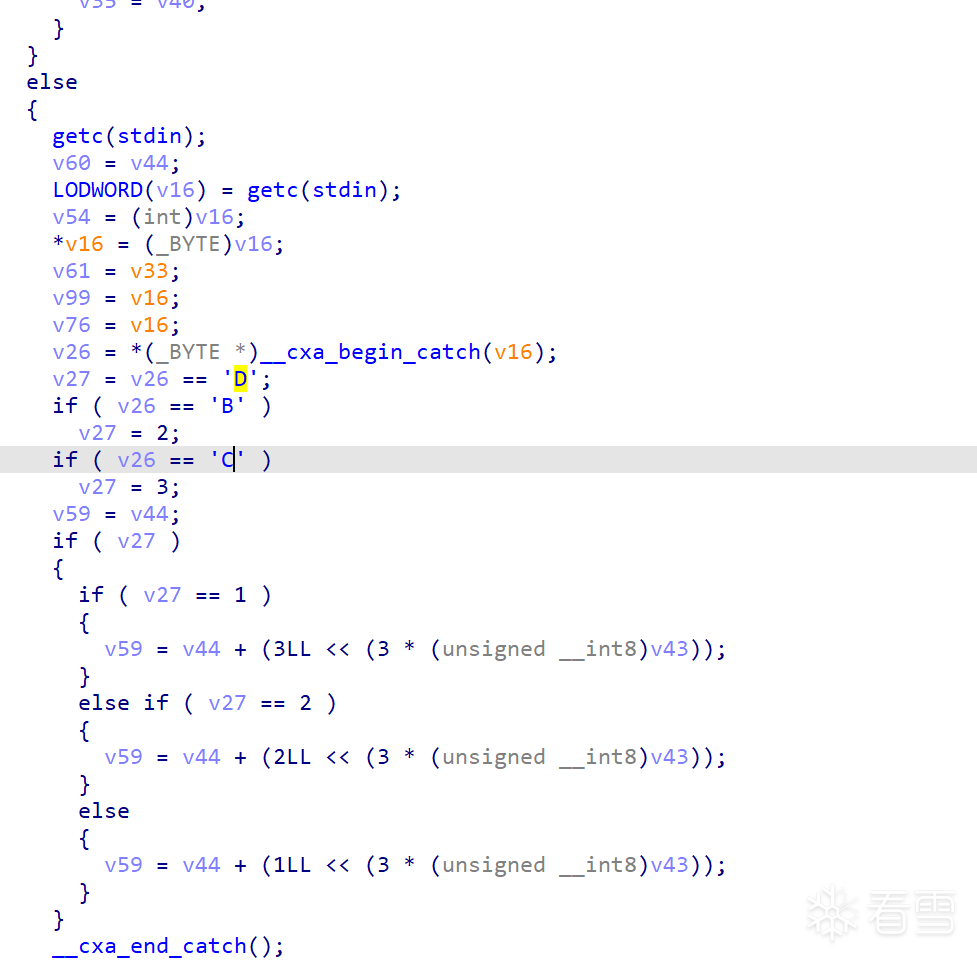
int part1_size = 12;
while(count < part1_size) {
  char a = getchar();
  if (a == 27) {
    if (getchar() == 91) {
      char c = getchar();
      try {
        rmCjJ0(true, c);
      } catch(Le3KW5 &cc) {
        char c = cc.state;
        if (c == 65) {
          state += 0ull << (3 * count);
        } else if (c==66) {
          state += 2ull << (3 * count);
        } else if (c==67) {
          state += 1ull << (3 * count);
        } else if (c==68) {
          state += 3ull << (3 * count);
        }
      }
      flag[count] = c;
    }
  } else if (a=='1') {
    state += 4ull << (3 * count);
    flag[count] = a;
  } else if (a=='7') {
    state += 5ull << (3 * count);
    flag[count] = a;
  } else if (a=='3') {
    state += 6ull << (3 * count);
    flag[count] = a;
  } else if (a=='4') {
    state += 7ull << (3 * count);
    flag[count] = a;
  }
  count += 1;
}
// ... Second Part ...
// Check Part
if (... && state == 0xb3e659480) {
  std::cout << LIT("Congratulation!
") << LIT("Your flag is ACTF{") << flag << LIT("_amazing!}") << std::endl;
}
PART TWO
这个部分完全跟着lchild的分析来了。 接着就是第二段输入。首先是经过一段Base64解码操作,再经过取模除十操作得到一个数组。
  if ( (_DWORD)v50 == 4 )
  {
    do
    {
      v106 = 0LL;
      v149 = v146;
      do
      {
        baseTable[v106 + 16] = byte_40E071[v106] - byte_40E0B2[v106];// baseTable
        ++v106;
      }
      while ( v106 < 0x41 );
      v56 = (__int64)v163;
      *(_QWORD *)v163 = v164;
      v165 = 64LL;
      v169 = (_OWORD *)std::basic_string,std::allocator>::_M_create(
                         v56,
                         &v165,
                         0LL);
      v9 = (void **)v163;
      v10 = v169;
      *(_QWORD *)v163 = v169;
      v11 = v165;
      *(_QWORD *)v164 = v165;
      v12 = MEMORY[5];
      v13 = MEMORY[0x15];
      v14 = MEMORY[0x25];
      v10[3] = MEMORY[0x35];
      v10[2] = v14;
      v10[1] = v13;
      *v10 = v12;
      *(_QWORD *)v187 = v11;
      *((_BYTE *)v10 + v11) = 0;
      v15 = v149;
      *(©_input1 + v15) = std::basic_string,std::allocator>::find(
                                v9,
                                (unsigned int)*(©_input1 + v149),
                                0LL);
      v177 = *v9;
      operator delete(v177);
      v146 = v149 + 1;
    }
    while ( v149 != 3 );
    v17 = *v186;
    *v183 = (4 * *v57) | ((unsigned __int8)*v186 >> 4) & 3;
    v18 = *v185;
    *v59 = (16 * v17) | ((unsigned __int8)*v185 >> 2) & 0xF;
    *v184 = *v58 + (v18 << 6);
    v152 = v110;
    v151 = 0LL;
    do
    {                                         // 对输入进行操作分值操作
      v6 = v151;
      v7 = (unsigned __int8)*(&v99 + v151) / 0xAu;
      v8 = v152;
      baseTable[v152 + 96] = (unsigned __int8)*(&v99 + v151) % 0xAu;
      baseTable[v8 + 97] = v7;
      v151 = v6 + 1;
      v152 = v8 + 2;
      v182 = v8 + 2;
    }
    while ( v6 != 2 );
    v130 = 0LL;
    v112 = v182;
  }
  v128 = v130;
  v113 = v112;
  copy_len = v133;
  v147 = v181;
}
while ( v133 );                               // 以上是对input进行了base64解码
之后计算了九个数值,和一堆pang臭的代码,不过干的事情不是很复杂。
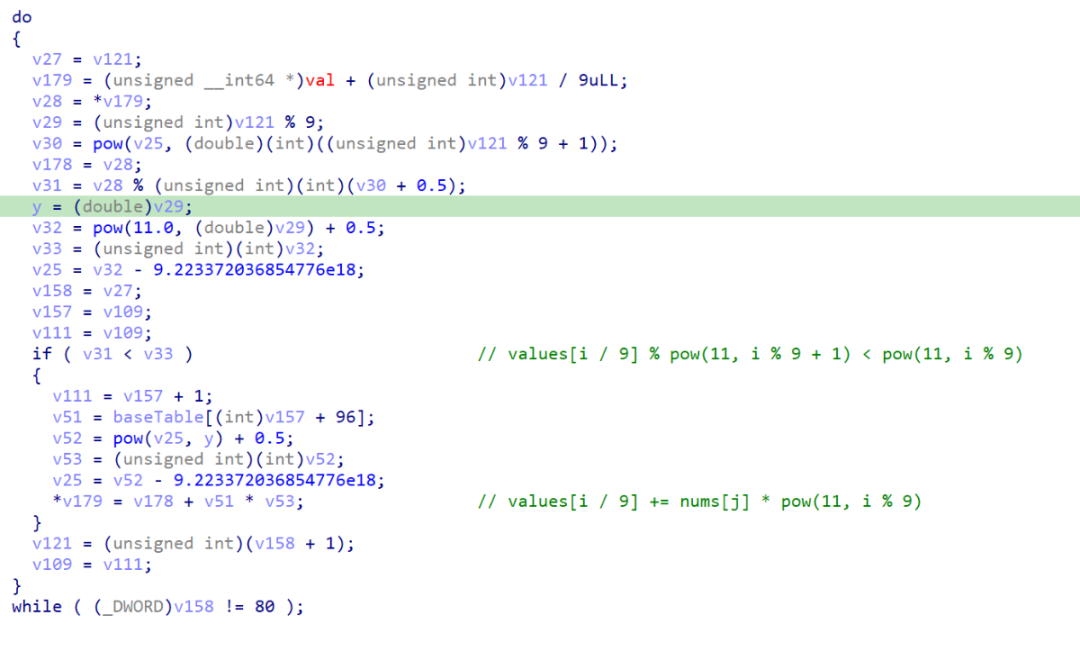
具体参考lchild师傅的Write up
# https://sudoku.vip/sudoku-x-solver/
0x04 GetFlag!!
第一个解密就直接移回去即可。 第二个解密出数独的值,列移动,取出值恢复原权位值,最后Base64即可!
s = []
t = 0xB3E659480
# 每3个字节为一次输入
for i in range(12):
    s.append(t & 0x7)
    t >>= 3

assert t == 0
key = ''
for i in s:
    if i == 0: key += '↑'
    elif i == 1: key += '→'
    elif i == 2: key += '↓'
    elif i == 3: key += '←'
    elif i == 4: key += '1'
    elif i == 5: key += '7'
    elif i == 6: key += '3'
    elif i == 7: key += '4'
print(key) # ??↓↓→←→←3417

values = [0x00000000331b6d84, 0x0000000054cab29a, 0x000000000cd0afcd,
0x000000006636db08, 0x0000000000021528, 0x0000000005d62020, 0x00000000070bc7c1,
0x00000000006739bd, 0x00000000001b084a]
table = []
for i in values:
    table.append([])
    s = ''
    value = i
    for j in range(9):
        table[-1].append(int(value % 11))
        s += "%2d" % (value % 11)
        value /= 11
 #   print(s[2: ] + s[: 2])
'''
 0 0 0 0 0 0 0 4 0
 0 0 5 0 0 0 7 6 0
 0 0 0 0 4 0 0 1 0
 0 0 0 0 0 0 0 8 0
 0 6 3 9 0 0 0 0 0
 0 0 0 0 3 0 5 0 0
 2 9 0 0 8 0 6 0 0
 0 7 0 0 9 3 0 0 0
 3 0 0 0 0 1 0 0 0
'''

# print(sum(table, []).count(0))
# https://sudoku.vip/sudoku-x-solver/

solves = [
[8, 1, 6, 7, 5, 2, 3, 4, 9],
[4, 3, 5, 8, 1, 9, 7, 6, 2],
[7, 2, 9, 3, 4, 6, 8, 1, 5],
[9, 4, 7, 1, 6, 5, 2, 8, 3],
[5, 6, 3, 9, 2, 8, 4, 7, 1],
[1, 8, 2, 4, 3, 7, 5, 9, 6],
[2, 9, 1, 5, 8, 4, 6, 3, 7],
[6, 7, 4, 2, 9, 3, 1, 5, 8],
[3, 5, 8, 6, 7, 1, 9, 2, 4]
]

# 数独列右移
for i in range(9):
    solves[i] = [solves[i][-1]] + solves[i][: -1]
#    print(solves[i])

numbers = []
for y in range(9):
    for x in range(9):
            if table[y][x] == 0:
#                print(table[y][x])
                numbers.append(solves[y][x])

assert len(numbers) % 2 == 0

flag = ''
for i in range(0, len(numbers), 2):
    flag += chr(numbers[i] + 10 * numbers[i + 1])

import base64
# print(flag)
print(base64.b64encode(str.encode(flag)))

# ↑↑↓↓→←→←3417
# WT05ICpTW0tcPyYxETgMGTBDUSphES1TLgwtVUwd
最后输入上上下下右左右左3417再二段。 GetFlag!!










 工商网监
工商网监
评论