


 香港理工大学、南方科技大学:新型压阻式石墨烯/CNC声学传感器,用于语音识别

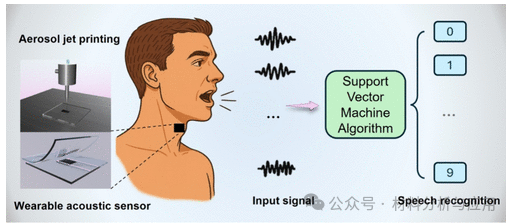
可穿戴声学传感器通过校准喉部振动并将其转化为合成语音,为语言障碍者提供了有效的沟通解决方案。本文,香港理工大学Zhongqing SU、南方科技大学周利民教授等在《ACS Sens》期刊发表名为“An Aerosol Jet-Printed Wearable Graphene/Cellulose Nanocrystal Acoustic Sensor for Speech Recognition”的论文,研究开发了一种新型压阻式声学传感器,通过气溶胶喷射打印技术,采用聚氨酯(PU)薄膜封装石墨烯/纤维素纳米晶体(CNCs)进行增材制造。该传感器具有高度生物相容性和柔韧性,能够精确测量变化的声音压力水平(SPL)。
实验结果表明,通过调节石墨烯浓度可调控传感器的声学灵敏度。当石墨烯浓度为20%时,传感器展现出9.7×10⁻⁶ dB⁻¹的高灵敏度,工作范围覆盖30至90 dB,声压级变化最小分辨率达10 dB,且声压级与传感器测得的电阻变化呈线性相关。当作为可穿戴设备贴附于受试者喉部时,该传感器能精准捕捉音色、节奏等细微发声特征。结合基于支持向量机(SVM)的机器学习算法,该设备在识别数字(0-9)时达到95.9%的高准确率,助力语言障碍者实现数字化沟通。
图文导读
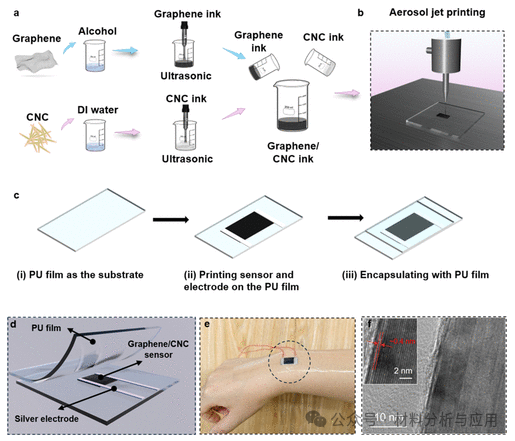
图 1. (a) Fabrication flow of sensor ink; (b) schematic of the acoustic sensor fabricated using AJP; (c) schematic diagram of the wearable acoustic device preparation process; (d) schematic of the acoustic device; (e) device worn on the skin; (f) cross-sectional TEM image of the GC-20%G.

图2. Schematic of the sensor conductive path at initial condition (a) and sound acoustic pressure-loaded environment (b).
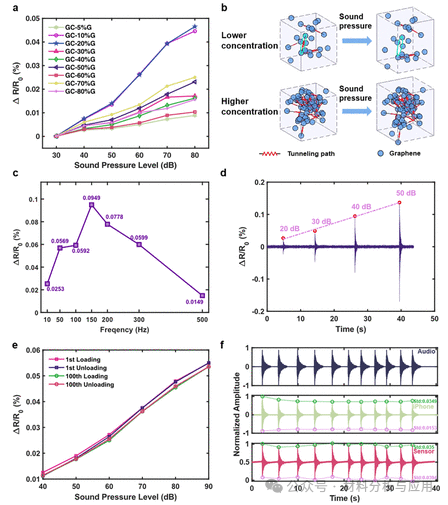
图3. Acoustic response of the sensor. (a) Response of sensors at varying sound pressure level; (b) schematic diagram of the change in tunneling path of sensors with lower and higher graphene concentrations under sound pressure; (c) frequency response of the GC-20%G sensor under a representative SPL of 80 dB with different frequencies (from 10 to 500 Hz); (d) real-time response signal of the sensor to the signal with gradually increasing sound pressure level; (e) relative resistance changes with the 1st and 100th cyclic sound pressure levels; (f) three acoustic waveforms from repeated playback of the same audio segment at 80 dB SPL: original loudspeaker signal, iPhone recording, and GC-20%G sensor output.
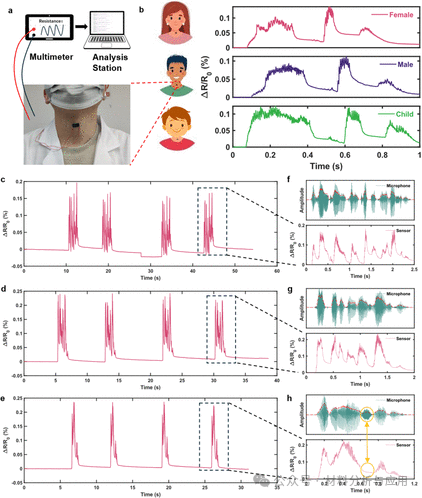
图4. Acoustic device for voice detection. (a) Wearable acoustic device attached on the throat; (b) relative resistance change of the sensor when three different volunteers say, “Merry Christmas”; (c−h) relative resistance change of the sensor in response to three different sentences, compared with the microphone signal; (c, f) is the signal response of “The Hong Kong Polytechnic University”; (d, g) is the signal response of “Hope everything goes well with you”; and (e, h) is the signal response of “What a nice weather”.
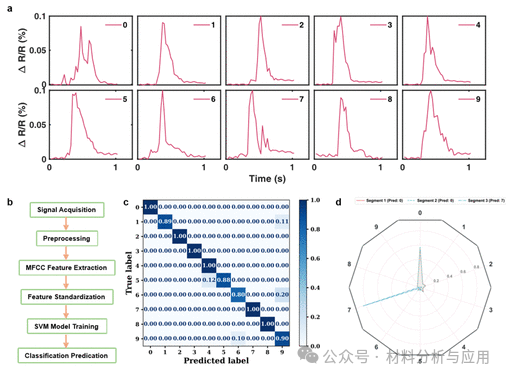
图5. Acoustic devices for digits 0–9 recognition. (a) Signal of digits from 0 to 9 captured by the sensor; (b) schematic flowchart of speech recognition; (c) classification confusion matrix of digit 0–9 prediction versus the test data set; (d) recognition of a sequence of digits “007”.
小结
本研究采用AJP工艺成功制备了新型压阻式石墨烯/碳纳米管(CNC)声学传感器,并采用聚氨酯薄膜封装以增强柔韧性与贴合皮肤的能力。石墨烯浓度为20%(GC-20%G)的传感器展现出9.7×10⁻⁶ dB⁻¹的最高灵敏度,以及10 dB的最小声压级变化分辨率,从而实现精准声学检测。该传感器在30至90分贝声压级范围内表现出低滞后特性与优异可逆性,并具备卓越的重复测量稳定性:局部最大响应与最小响应的标准差值仅分别为0.035和0.0349。该可穿戴声学设备固定于受试者喉部,能可靠捕捉声带振动,从而精确识别语音模式、音调变化及独特音频信号。基于机器学习训练的SVM模型能以95.9%的准确率识别传感器采集的语音数字信号,证明其解读语音信号语义内容的能力。这些成果彰显了传感器的检测与识别潜力,为语障人士的通信技术应用拓展了广阔前景。
展望未来,通过更大规模、更丰富多样的数据集训练模型,有望实现更复杂语音模式的识别——从数字扩展至完整词汇与短语,从而拓展其在人机交互、医疗健康及无障碍技术领域的应用场景。此外,将运用分子动力学模拟深入探究微尺度隧道效应机制,通过定量分析为新一代高性能声学传感器的理性设计提供指导。
审核编辑 黄宇
-
语音识别
+关注
关注
39文章
1822浏览量
116234 -
声学传感器
+关注
关注
1文章
30浏览量
10884
发布评论请先 登录
北京理工大学集成电路与电子学院和紫光同创国产FPGA课赛结合实验室揭牌
新加坡南洋理工大学到访水晶光电参观交流
长春理工大学领导一行莅临联合光电参观交流
合众思壮与河南理工大学达成战略合作
晟矽微电与上海理工大学深化产学研合作
中汽中心赴武汉理工大学走访交流
上海理工大学师生一行走进简仪科技总部
武汉理工大学领导一行到访华工科技
北京理工大学生命学院:研发新型电化学生物传感器,聚焦血糖监测技术突破
华东理工大学信息学院校友会走访兆芯
上海理工大学师生一行莅临意瑞半导体参观交流
香港理工大学选购我司HS-TGA-101热重分析仪
奥迪威携手华南理工大学共建联合创新实验室,校企深度合作助力产业升级
广电计量与重庆理工大学达成战略合作
北京理工大学:研究眼机界面智能传感硬件——从可穿戴到仿生



评论