


 使用paramiko在eNSP的交换机中批量创建VLAN

来源:公众号【网络技术干货圈】
作者:圈圈
ID:wljsghq
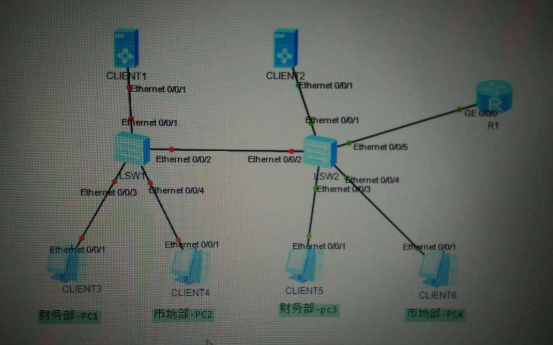
实验拓扑:
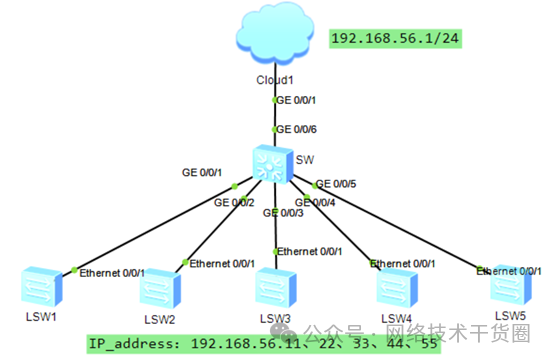
cloud连接本机,ip地址为192.168.56.1,五台交换机的配置的地址为192.168.1.11~55。现在通过paramiko,ssh进入五台设备,并且在五台设备上分别创建vlan10-vlan20这11个VLAN。
版本:python3.9
实验步骤:
一、ssh配置:
##创建秘钥
[sw2]dsalocal-key-paircreate

##配置SSH认证类型(密码/其他)
[sw2]sshuserprinauthentication-typepassword
[sw2]sshuserprinservice-typestelnet
[sw2]stelnetserverenable

##配置认证模式
[sw2]user-interfacevty04
[sw2-ui-vty0-4]authentication-modeaaa//配置认证模式
[sw2-ui-vty0-4]protocolinboundssh//允许ssh连接虚拟终端

##配置本地用户信息
[sw2]aaa
[sw2-aaa]local-userprinpasswordcipherHuawei@123
[sw2-aaa]local-userprinprivilegelevel15
[sw2-aaa]local-userprinservice-typessh
二、python脚本:
importparamiko
importtime
importgetpass

#使用input函数,输入SSH的用户名
username=input('Username:')
#通过getpass()函数接收密码,密码是不可见的,但是在windows上有bug,密码可见
password=getpass.getpass('Password:')

#创建一个列表,表示五台设备最后8位的地址
ip_tail_list=[11,22,33,44,55]

#使用for循环,接受SSH的秘钥,并分别依次连接到五台设备,注意需要将i转化为字符串
foriinip_tail_list:
ip="192.168.56."+str(i)
ssh_client=paramiko.SSHClient()
ssh_client.set_missing_host_key_policy(paramiko.AutoAddPolicy())
ssh_client.connect(hostname=ip,username=username,password=password)

print("Successfullyconnectto",ip)

#使用invoke_shell()唤醒shell界面
command=ssh_client.invoke_shell()

#使用command.send()函数创建VLAN,并且设置每个VLAN的描述;未来保证设备能够正常接受配置,每次创建1个VLAN后休息1s
command.send("system
")

forninrange(10,21):
print("CreatingVlan"+str(n))
command.send("vlan"+str(n)+"
")
command.send("descriptionPythonVlan"+str(n)+"
")
time.sleep(1)

#保存配置,并且通过command.recv()函数得到回信的信息,最多接受65535个字符
command.send("return
")
command.send("save
"+"y
"+"
")
time.sleep(2)
output=command.recv(65535)
print(output.decode('ascii'))

#关闭连接
ssh_client.close()
如果管理的设备数目过多,可以直接通过读取txt文件的方式获取IP地址,仅需要将如下代码:
#创建一个列表,表示五台设备最后8位的地址
ip_tail_list=[11,22,33,44,55]

#使用for循环,接受SSH的秘钥,并分别依次连接到五台设备,注意需要将i转化为字符串
foriinip_tail_list:
ip="192.168.56."+str(i)
ssh_client=paramiko.SSHClient()
ssh_client.set_missing_host_key_policy(paramiko.AutoAddPolicy())
ssh_client.connect(hostname=ip,username=username,password=password)
#......省略中间部分
ssh_client.close()
更换为下述即可:
#使用open()函数打开ip_list文件,并将读取的结果赋予f
f=open("ip_list.txt","r")

#调用readlines()函数,返回IP地址的列表,并使用for循环遍历;注意使用readlines()的每一个ip地址后带有
,需要通过strip()函数去除
foriinf.readlines():
ip=i.strip()
ssh_client=paramiko.SSHClient()
ssh_client.set_missing_host_key_policy(paramiko.AutoAddPolicy())
ssh_client.connect(hostname=ip,username=username,password=password)
#.......省略中间部分,在完成文件操作后,关闭文件
f.close()
ssh_client.close()
执行效果:
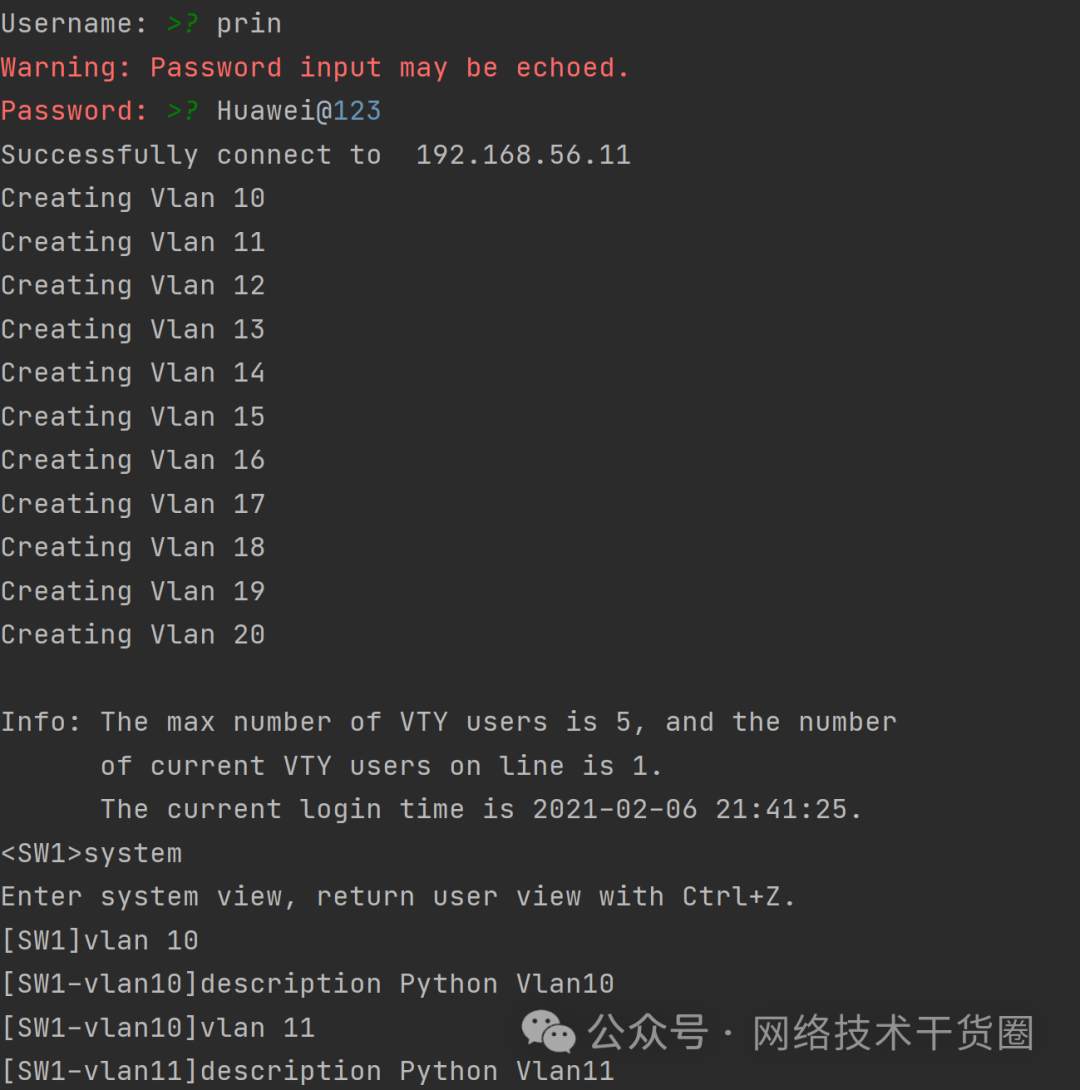
…
在设备上检查是否配置成功,以SW1为例: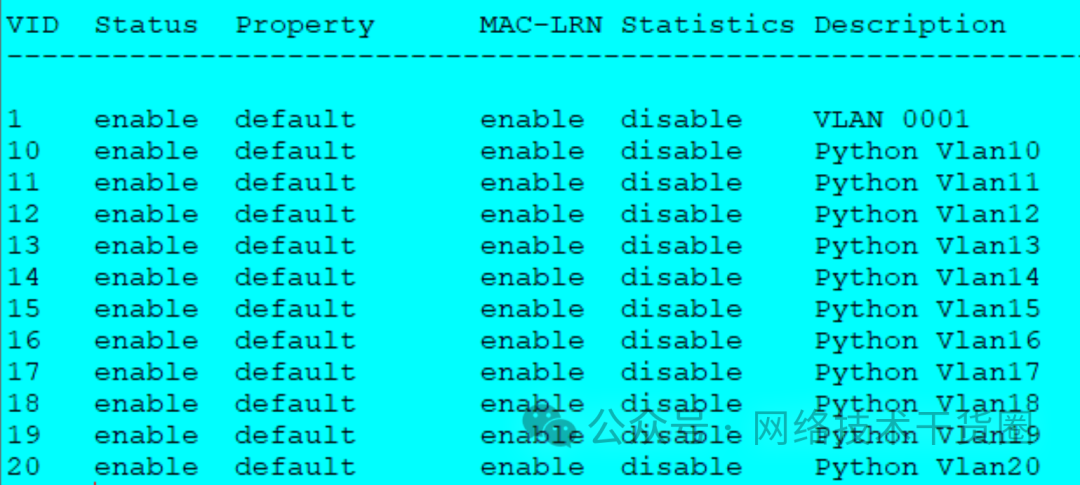
可以看到创建VLAN和添加VLAN描述成功。
审核编辑:汤梓红
声明:本文内容及配图由入驻作者撰写或者入驻合作网站授权转载。文章观点仅代表作者本人,不代表电子发烧友网立场。文章及其配图仅供工程师学习之用,如有内容侵权或者其他违规问题,请联系本站处理。
举报投诉
-
交换机
+关注
关注
23文章
2969浏览量
105078 -
VLAN
+关注
关注
1文章
292浏览量
38109 -
网络技术
+关注
关注
1文章
299浏览量
31308 -
python
+关注
关注
60文章
4895浏览量
90574 -
脚本
+关注
关注
1文章
415浏览量
29351
原文标题:使用paramiko在eNSP的交换机中批量创建VLAN
文章出处:【微信号:网络技术干货圈,微信公众号:网络技术干货圈】欢迎添加关注!文章转载请注明出处。
发布评论请先 登录
相关推荐
热点推荐
ISM交换机如何添加VLAN呢?
两台交换机额直接,PC连接F1/1 VLAN100 。
两台交换机设置是一样的,登录交换机192.168.2.2 用户名 adm 密码 123456 虚拟局域网 新增
发表于 07-25 07:55
[分享]常见网络交换机故障及应用问答
是否正确,交换机是否正常。若是设置故障,先检查交换机是否设置了IP地址,如果设置了和其他设备不在同一网段的IP地址,将其删除或设一个和其他设备在同一网段的IP地址;然后再看看是否是VLAN
发表于 06-02 11:31
华为路由器交换机VLAN配置实例
华为路由器交换机VLAN配置实例[hide]华为路由器交换机VLAN配置实例使用4台PC(pc多和少,原理是一样的,所以这里我只用了4台pc),华为路由器(R2621)、
发表于 05-25 00:21
交换机路由VLAN配置视频教程
交换机路由VLAN配置视频教程
VLAN是一种将局域网设备从逻辑上划分成一个个网段,从而实现虚拟工作组的新兴数据交换技术。这一新兴技术主要应用于交
发表于 09-09 16:20
•151次下载
中、小局域网交换机VLAN的网络配置
中、小局域网交换机VLAN的网络配置
有关VLAN的技术标准IEEE 802.1Q早在1999年6月份就由IEEE委员正式颁布实施了,而且最早的
发表于 10-20 09:22
•1161次阅读
聊聊科地网管PoE交换机的VLAN如何配置
VLAN就是我们常说的虚拟局域网。VLAN是一种将局域网设备从逻辑上划分成多个网段,从而实现虚拟工作组的数据交换技术。这一技术主要应用于交换机和路由器
交换机划分vlan的原因是什么
有很多朋友就问到老胡vlan如何分配,这个是交换机在划分网络的时候会常用到,这里面我们就以最直接了解下,单独对vlan基本操作,方便我们日常处理交换
发表于 08-18 15:44
•2486次阅读
配置不同VLAN之间通讯-使用三层交换机
在一台交换机上划分多个VLAN,正常情况下,不同的VLAN是不能互相通信,这是因为VLAN隔离了广播 域,但有时需要他们能相互访问,下面通过



评论