




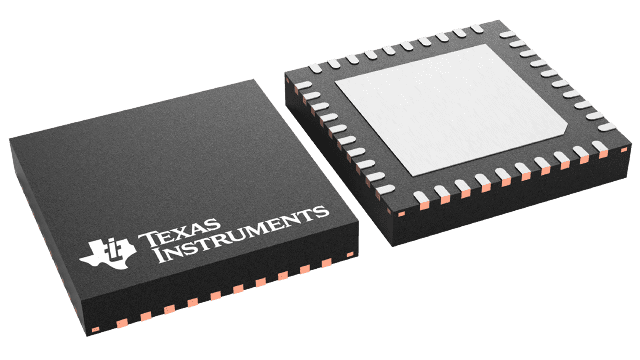
| Features | Dot Correction, Error Flag, Fault Detection, LED Open Detection, LED Short to Ground Detection, LED Short to VLED Detection, PWM LED Driver, Power Good, Thermal Shutdown |
| Analog dimming steps | 256 |
| Data transfer rate (Typ) (MHz) | 30 |
| Ch to ch accuracy (Typ) (+/- %) | 1.5 |
| Rating | Catalog |
| Operating temperature range (C) | -40 to 85 |
- 24-Channel Constant-Current Sink Output
- Current Capability: 40 mA
- Selectable Grayscale (GS) Control With PWM:
12-Bit (4096 Step), 10-Bit (1024 Step), 8-Bit (256 Step) - Three Independent Grayscale Clocks for Three Color Groups
- Dot Correction (DC): 7-Bit (128 Step)
- Global Brightness Control (BC) for Each Color Group: 8-Bit (256 Step)
- Auto Display Repeat Function
- Independent Data Port for GS and BC and DC Data
- Communication Path Between Each Data Port
- LED Power-Supply Voltage up to 15 V
- VCC = 3 V to 5.5 V
- Constant-Current Accuracy:
- Channel-to-Channel = ±1.5%
- Device-to-Device = ±3%
- CMOS Logic Level I/O
- Data Transfer Rate: 30 MHz
- 33-MHz Grayscale Control Clock
- Continuous Base LED-Open Detection (LOD)
- Continuous Base LED-Short Detection (LSD)
- Thermal Shutdown (TSD) With Auto Restart
- Grouped Delay to Prevent Inrush Current
- Operating Ambient Temperature: –40°C to 85°C
- Packages: HTSSOP-38, QFN-40
The TLC5951 device is a 24-channel, constant-current sink driver. Each channel has an individually-adjustable, 4096-step, pulse-width modulation (PWM) grayscale (GS) brightness control and 128-step constant-current dot correction (DC). The dot correction adjusts brightness deviation between channels and other LED drivers. The output channels are grouped into three groups of eight channels. Each channel group has a 256-step global brightness control (BC) function and an individual grayscale clock input.
GS, DC, and BC data are accessible via a serial interface port. DC and BC can be programmed via a dedicated serial interface port.
The TLC5951 device has three error-detection circuits for LED-open detection (LOD), LED-short detection (LSD), and thermal error flag (TEF). LOD detects a broken or disconnected LED, LSD detects a shorted LED, and TEF indicates an overtemperature condition.